Table of Contents
ToggleQuick Answer
Can dogs eat mandarin oranges? Yes, in small amounts. The peeled, seedless flesh is a safe treat for most healthy dogs. Take off the peel and the white pith first, skip canned fruit in syrup and juice, and keep it occasional and within the 10% treat rule.
Quick Facts
| Verdict | What to know | |
|---|---|---|
| Peeled mandarin segments | ✅ Safe | One or two at a time |
| Clementines, tangerines, satsumas, Cuties | ✅ Safe | Same rules as any mandarin |
| Peel | 🛑 No | Hard to digest, and its oils can upset the stomach |
| White pith | ⚠️ Caution | Tough to digest. Pull off what you can |
| Seeds | ⚠️ Caution | Remove them. A small dog could choke |
| Canned in syrup, juice, dried | 🛑 No | Added sugar and concentrated sweetness |
| How often | Occasionally | A treat, not a meal |
Mandarins are the fruit that shows up in lunch boxes, holiday stockings, and the bottom of every bag, and a dog is usually watching when one gets peeled. The question that matters is not whether the fruit is poisonous. Plain, peeled mandarin flesh is not a recognized toxin for dogs. The real questions are about the peel, the sugar, and how much a small stomach can take. If you came here asking can dogs eat mandarin oranges, the answer is yes, with the details below.
Mandarin, Tangerine, Clementine, Satsuma: What Is the Difference?
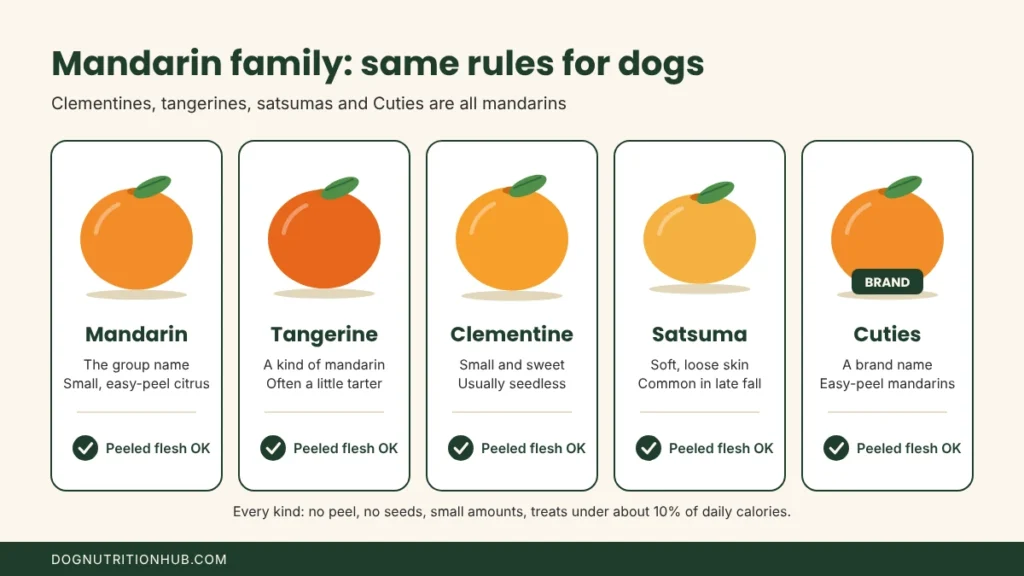
Can dogs eat mandarin oranges only, or do clementines and tangerines count too? They all count. “Mandarin” is the name of the whole group of small, loose-skinned, easy-peel citrus fruits. Tangerines, clementines, and satsumas are all kinds of mandarin, and Cuties is a brand name used in the U.S. for small easy-peel mandarins, not a different fruit.
Comparison chart of mandarin, tangerine, clementine, satsuma, and Cuties showing that all are easy-peel citrus and all follow the same rules for dogs
| Name | What it is | For your dog |
|---|---|---|
| Mandarin | The group name for small, easy-peel citrus | Peeled flesh in small amounts |
| Tangerine | A kind of mandarin, often a little tarter | Same rules |
| Clementine | A small, sweet, usually seedless mandarin | Same rules |
| Satsuma | A soft-skinned mandarin, often sold in late fall | Same rules |
| Cuties (and similar brands) | A brand name for easy-peel mandarins | Same rules, and the same peel warning |
So can dogs eat clementines? Yes. Can dogs eat tangerines? Yes. Can dogs eat Cuties oranges? Yes, with the same preparation as any mandarin: peel off, pith pulled away, seeds out. PetMD says ripe oranges, tangerines, and clementines are safe for dogs in moderation, and Purina says dogs can eat tangerines as long as you remove the peel and the white pith. The name on the bag does not change the verdict. The form does.
Are Mandarin Oranges Good for Dogs?
Can dogs eat mandarin oranges as a healthy snack? They are a reasonable occasional treat, mostly because they are juicy and low in calories per piece. Mandarins are about 85% water. Here is what raw mandarins contain per 100 grams, according to USDA FoodData Central:
| Per 100 g, raw | Mandarins (tangerines) |
|---|---|
| Calories | about 53 kcal |
| Water | about 85 g |
| Sugars | about 11 g |
| Fiber | about 2 g |
| Vitamin C | about 27 mg |
Source: USDA FoodData Central, “Tangerines (mandarin oranges), raw.”
Health benefits, and a reality check
- Juicy and hydrating. The high water content makes segments a refreshing snack on a warm day.
- Some vitamin C and fiber. Both are present in small amounts (USDA FoodData Central).
- Easy to portion. Mandarins come pre-divided into segments, which makes it simple to hand out one piece.
- Plant compounds. Citrus fruit contains flavonoids and other compounds studied in people. That research does not show a benefit for your dog from a few segments, so we do not claim one.
Keep this in perspective. A dog eating a complete and balanced dog food is not short of vitamin C or fiber, and dogs make their own vitamin C. Mandarin segments are a snack, not a supplement. They are also noticeably sweeter than berries, which is why the portion matters more than the benefits.
Which Parts of a Mandarin Are Safe?
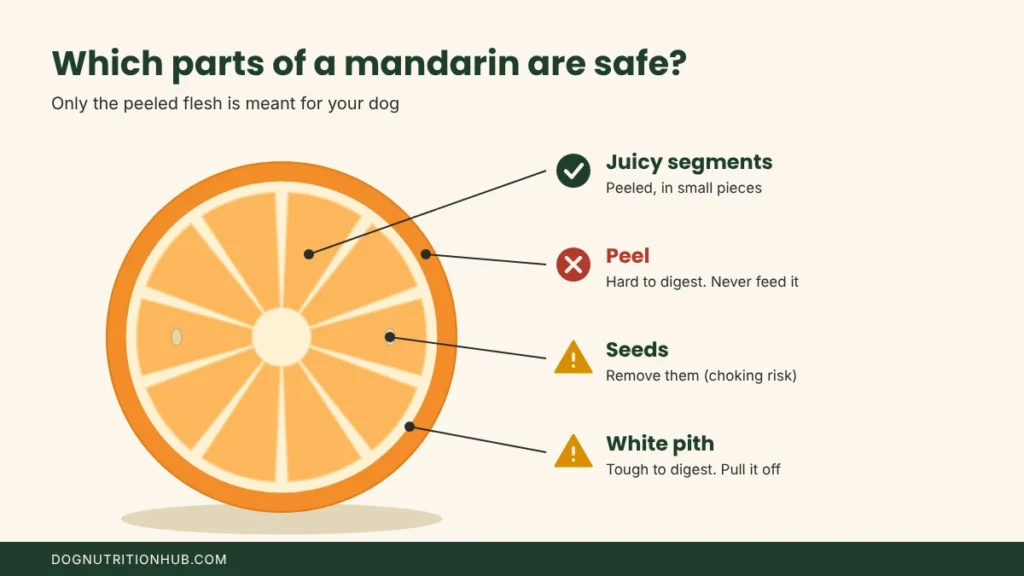
Can dogs eat mandarin oranges whole, the way they come out of the bag? No. Only one part of the fruit is meant for them.
| Part | Verdict | Why |
|---|---|---|
| Juicy segments (flesh) | ✅ | The part meant for eating |
| Peel (skin) | 🛑 | PetMD says peels are tough to digest and can cause intestinal blockages; the oils can irritate the stomach |
| White pith and membranes | ⚠️ | Tough to digest. Pull off the stringy bits |
| Seeds | ⚠️ | Not an established toxin, but sources advise removing them, and a small dog could choke |
| Leaves, stems, and fallen fruit from a tree | ⚠️ | ASPCA lists skins and plant material as potential problems. Fallen fruit may also be moldy |
Can Dogs Eat Mandarin Orange Peels?
Can dogs eat mandarin oranges with the peel on? No, and this is the one part owners most often get wrong, because the peel comes off in one easy piece and tends to end up on the counter or in the trash. A dog that grabs it can end up with a stomach upset or a blockage.
There are two separate issues:
- The oils. The ASPCA‘s entry for the orange plant names essential oils and psoralens as the toxic principles and says the fruit is edible, but skins and plant material can cause problems. Signs it lists include vomiting, diarrhea, and depression, and possibly skin irritation. Purina makes the same point for tangerines: the peel and pith contain compounds like essential oils that can be toxic to dogs in large amounts.
- The texture. PetMD says orange peels are tough to digest and can cause intestinal blockages. A chunk of rubbery peel is a bigger concern for a small dog than the oil is.
A small nibble of peel usually means a stomach upset at worst, but you should not offer it on purpose. Keep peels out of reach: in a closed bin, not in a bowl on the coffee table.
Are Mandarin Oranges Bad for Dogs?
Can dogs eat mandarin oranges without any risk? For most healthy dogs, plain peeled segments are not bad. The problems come from a short list of things.
Too many at once. Mandarins are acidic and sweet. A lot of segments can cause gas, vomiting, or diarrhea, especially in dogs with sensitive stomachs. Purina notes that acidic foods like tangerines can cause diarrhea and vomiting. This is the most common problem.
Sugar and calories. Mandarin sugar is natural sugar, but it is still sugar. A bag of mandarins is easy to eat through, and the same is true for a dog that learns where the bag lives. Both Purina and PetMD advise against citrus for overweight or diabetic dogs.
The peel. Covered above. It is the main avoidable risk.
Mold. A mandarin that has been sitting in the bottom of a bag can grow mold. Check before you share, and never feed a soft, leaking, or moldy one.
A rare issue: individual sensitivity. Some dogs simply do not tolerate citrus. If your dog gets loose stools, drools, or turns away after a segment, stop and do not offer it again.
Are the seeds a problem?
Can dogs eat mandarin oranges with the seeds in? Many mandarins are seedless, and Purina describes tangerines as naturally seedless, but not every fruit is. Seeds and pith are not established toxins. Still, PetMD lists seeds among the parts to remove, and a seed is a choking risk for a small dog. Take them out and the question goes away.
Can Dogs Have Mandarin Oranges Every Day?
Can dogs eat mandarin oranges every day? It is better to keep them occasional. A healthy dog may tolerate a segment on many days, but there are good reasons to treat it as a snack and not a habit:
- Treats should not crowd out the main diet. Your dog’s food supplies what it needs.
- The sugar adds up. A segment is nothing. A whole mandarin, every day, is a different story for a small dog.
- The acid adds up too. Repeated citrus is a classic way to a loose stool.
- The 10% rule applies. Both Purina and PetMD say treats should make up no more than 10% of a dog’s daily calories. Mandarins count toward that, along with biscuits and chews.
If your dog has diabetes or is on a weight management plan, ask your veterinarian before adding mandarins to the diet.
Can a Dog Have a Mandarin Orange? How Much Is Too Much
Can a dog have a mandarin orange? Yes, as segments, not as a whole fruit. Can dogs eat mandarin oranges by the bagful? No. There is no single number that suits every dog, and we do not give one, because no reliable mandarin-specific figure exists. A simple approach works better:
- Start with one segment. Purina suggests starting with one small section and watching your dog’s reaction. If the stomach stays settled for a day, it can be an occasional treat.
- Think “treat,” not “serving.” One or two segments is a treat. A whole mandarin is a meal’s worth of sugar for a small dog.
- Match the piece to the dog. Break segments into smaller pieces for small dogs.
- Count them as calories. If you give mandarins regularly, adjust the rest of the day’s food and treats.
Can Small Dogs and Large Breeds Eat Mandarin Oranges?
The fruit doesn’t change. Can dogs eat mandarin oranges at any size? Yes: a peeled segment is just as safe for a Chihuahua as for a Border Collie. What changes is how little of it counts as a portion.

Small and toy breeds. Chihuahuas, Yorkies, Pomeranians, and Dachshunds need very little: a single segment broken into pieces is plenty, and for the smallest dogs even part of one. Their stomachs are small, and a few segments can easily be too much.
Medium dogs. Beagles, Cocker Spaniels, and Border Collies can have a segment or two as an occasional treat. Keep the count modest.
Large and giant breeds. Labradors, German Shepherds, and Great Danes can have a few segments, but “a few” is still a treat. A big dog can still get loose stools from too much citrus.
Active and working breeds. Border Collies, Australian Shepherds, and Huskies burn more calories, but that doesn’t make mandarins a free food. Extra energy needs are better met by adjusting main meals than by adding treats.
Breeds with a wide weight range. Poodles, Dachshunds, and Spaniels vary enormously within the same breed name. Go by your dog’s actual weight, not the breed label.
Breeds prone to weight gain. Labradors, Beagles, Pugs, and Cocker Spaniels gain weight easily, and fruit sugar counts too. Keep mandarins to a small, occasional treat.
Puppies. Puppies have smaller stomachs and less tolerance for anything new. Offer one small piece of one segment, watch how they react, and ask your veterinarian before making fruit a regular part of a puppy’s diet.
Unlike many fruits, mandarins have no pit, so what changes with size is mostly quantity and choking risk from seeds and peel. A segment count that suits a Great Dane is far too much for a toy breed.
Size changes the portion, not the form. Canned mandarins in syrup, juice, and sweetened products are off the menu for every dog at every weight. A large dog does not get a pass on them.
If your dog has diabetes or is on a weight management plan, ask your veterinarian regardless of breed or size.
📥 Free Download: Safe & Toxic Foods Chart for Dogs
Print it, stick it on the fridge, and know at a glance what’s safe — before you share.
Can Dogs Eat Oranges or Tangerines?
Many owners ask about the whole citrus family at once. Can dogs eat oranges or tangerines? Both, using the same rules. PetMD lists ripe oranges, tangerines, and clementines as safe in moderation, and the rules are the same for each: flesh only, no peel, no seeds, small amounts. Full-size oranges are a little larger and a bit more acidic, so the portion for a small dog is still a piece of a segment.
A few things change when you move away from mandarins:
- Oranges. Bigger, thicker peel, more seeds in some kinds. We cover them in a separate guide, including blood oranges and Cara Cara. Can Dogs Eat Oranges
- Lemons and limes. Much more sour, and much less appealing to most dogs. They are not a good treat.
- Grapefruit. Bitter, and also a poor choice for a dog treat.
Can dogs eat oranges mandarins style, with the peel still on, as in “a whole fruit for the dog”? No. The answer is the same as for any citrus: the flesh, yes; the skin, no.
Mandarin Products to Skip
The fruit is safe. Most things made from it are not. Plain segments are simple, but mandarins show up in many forms, and each one adds something your dog does not need.
- Canned mandarin oranges in syrup. Syrup makes the fruit a sugar-heavy treat. Even “in juice” versions are concentrated in sugar. Fresh is better.
- Fruit cups. Many are packed in juice or syrup, and some “diet” or “no sugar added” versions use sweeteners. If the label lists xylitol, skip it entirely, because xylitol is poisonous to dogs. Read our guide on xylitol poisoning in dogs.
- Mandarin juice and orange-style juice. PetMD describes orange juice as non-toxic but not recommended as a treat, because it is high in sugar and very acidic. Juice removes the fiber and concentrates the sugar.
- Dried or candied mandarin and peel. Drying concentrates the sugar into a chewy piece that is easy to overfeed, and candied peel is mostly sugar.
- Marmalade, jam, and mandarin desserts. Sugar, and sometimes xylitol, butter, or raisins.
- Mandarin-flavored candy, drinks, and gum. Flavorings and sweeteners, possibly xylitol.
- Citrus essential oils. Concentrated oils are not food. Keep them off your dog and out of reach.
Can dogs eat mandarin oranges in these forms? No. The same pattern runs through all of these. Fresh, plain fruit is the safe choice, and processing adds sugar or sweeteners that change the verdict. Our guide to processed foods for dogs explains why
What If My Dog Ate Too Many Mandarin Oranges?
If it was plain, peeled segments. Can dogs eat mandarin oranges in large amounts without trouble? Not usually. The common result is a mild stomach upset: gas, loose stools, vomiting, or diarrhea. Skip the fruit, keep fresh water available, and watch your dog. If the upset is severe, keeps getting worse, or does not settle, call your veterinarian.
If your dog ate a piece of peel. A small piece usually means, at worst, an upset stomach. A large amount of peel, a whole peel, or any peel in a small dog is a reason to call your veterinarian, even if your dog seems fine, because of the blockage risk. Call right away if your dog is retching without bringing anything up, has a swollen or painful belly, or stops eating.
If it was canned fruit, juice, or anything sweetened. Check the label for xylitol. If xylitol is listed, or you cannot tell, call your veterinarian or a pet poison hotline immediately.
If it was moldy fruit. Treat this as more serious. Mold can produce toxins that affect the nervous system. Contact your veterinarian or a pet poison hotline right away; do not wait for symptoms to appear.
How to Prepare and Serve Mandarin Oranges for Dogs
Can dogs eat mandarin oranges straight from the fruit bowl? Almost. A few seconds of preparation makes them dog-ready.
Five-step guide to preparing a mandarin for dogs: choose, peel, pull off the pith, remove seeds, serve a small piece plain
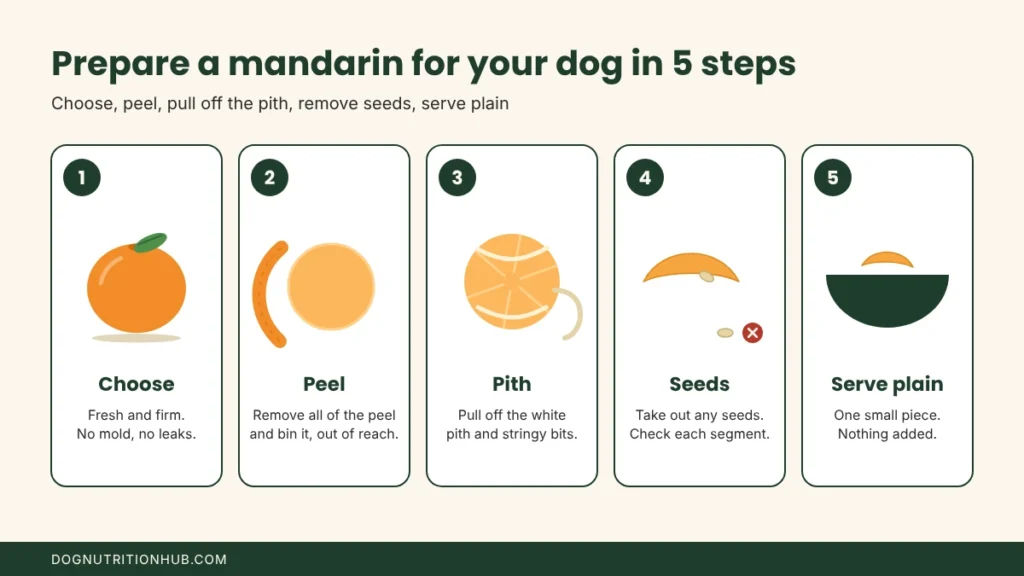
- Choose a fresh, firm fruit. Skip any that are soft, leaking, moldy, or smell fermented.
- Peel it completely, and throw the peel away where your dog cannot reach it.
- Pull off the white pith and stringy membranes as much as you can.
- Take out any seeds.
- Break off one segment, and cut it smaller for small dogs.
- Serve it plain. No sugar, honey, syrup, or seasoning.
- Store leftovers in the fridge. Throw them out if they turn soft or moldy.
Serving ideas:
- A single segment as a treat or training reward
- Chilled segments on a warm day
- Frozen pieces. Small pieces are fine; supervise your dog and keep them small enough not to be a choking risk
- A small piece pressed into a puzzle toy or lick mat
When to Call Your Veterinarian Right Away
Contact your veterinarian, an emergency clinic, or a pet poison hotline promptly if your dog:
- Ate a large amount of peel, or any peel and is a small dog
- Is retching, has a swollen or painful belly, or stops eating
- Ate canned fruit, candy, or sweets that may contain xylitol
- Ate moldy fruit
- Has repeated vomiting or diarrhea that does not settle
- Shows weakness, tremors, trouble breathing, or collapse
- Has a medical condition such as diabetes and ate a large amount
Can dogs eat mandarin oranges safely with a medical condition? Sometimes, but ask first. If you are in the US, ASPCA Animal Poison Control and the Pet Poison Helpline both offer round-the-clock advice; a consultation fee usually applies. When in doubt, call: it is always better to ask early.
Myth vs Fact
Myth: Because mandarins are healthy for people, a dog can have as many as it wants. Fact: The sugar and acid cause loose stools and vomiting in dogs, and the fruit counts toward the 10% treat limit.
Myth: A clementine, a tangerine, and a Cutie are three different foods for a dog. Fact: They are all mandarins. The same rules apply: flesh only, no peel, no seeds, small amounts.
Myth: The peel is the healthiest part, so a little is good for dogs. Fact: The peel is the part to avoid. It is tough to digest, and its oils can upset the stomach.
Myth: Canned mandarins are just as good as fresh. Fact: Canned fruit is usually packed in syrup or juice, which adds sugar. Fresh, plain segments are the better choice.
Myth: Citrus is toxic to dogs, so even the flesh is dangerous. Fact: The ASPCA says the fruit is edible, and that skins and plant material can cause problems. Plain, peeled flesh in small amounts is not a recognized toxin.
FAQ
Can puppies eat mandarin oranges?
Can dogs eat mandarin oranges as puppies? Puppies can usually have one small piece of one peeled segment, but their digestive systems are more sensitive. Offer a very small amount, watch for stomach upset, and ask your veterinarian before making it a regular treat.
Can dogs eat mandarin oranges frozen?
Yes, peeled frozen segments are fine for most dogs. Break them into small pieces, supervise your dog, and skip frozen products with added sugar.
Can dogs eat mandarin oranges from a can?
It is best to skip them. Canned mandarins are usually packed in syrup or juice, which adds a lot of sugar. If you ever choose a canned product, read the label for xylitol and other sweeteners first, and fresh fruit remains the better choice.
Are mandarin oranges safe or poisonous for dogs?
Plain, peeled mandarin flesh is safe for most dogs and is not poisonous. The real concerns are the peel, too many segments, added sugar in processed products, and mold. Dogs with diabetes or weight problems should not have them without a veterinarian’s approval.
Can dogs eat clementines and Cuties?
Yes. Clementines and Cuties are mandarins, so the rules are the same: peel off, pith pulled away, seeds out, one or two segments for most dogs. The peel on easy-peel fruit comes off easily, so make sure your dog cannot get to it.
Can dogs eat mandarin oranges if they have a sensitive stomach?
Can dogs eat mandarin oranges when the stomach is easily upset? It is safest to skip them, or to offer only a tiny piece, because citrus is acidic and can bring on vomiting or diarrhea. If your dog has had stomach trouble recently, ask your veterinarian before offering any new food.
Are mandarin oranges safe for diabetic or overweight dogs?
Mandarins contain natural sugar and calories. Purina and PetMD both advise against feeding oranges or tangerines to overweight or diabetic dogs, so ask your veterinarian before giving them.
Can dogs eat mandarin oranges and other citrus together?
A small amount of peeled mandarin is fine, and the citrus family follows the same rules: flesh only, small amounts. Very sour fruits such as lemons and limes are not a good treat, and the combined total of any citrus counts as one small treat.
The Bottom Line
So, can dogs eat mandarin oranges? Yes. Plain, peeled, seedless mandarin segments are a safe and refreshing treat for dogs of every size when served in small amounts. The same goes for clementines, tangerines, satsumas, and Cuties. The peel, the pith, the seeds, canned fruit, juice, and sweetened products should stay off the menu. Keep the count small, keep it occasional, and adjust for your dog’s size. If your dog has a health condition such as diabetes, ask your veterinarian first.
References
- USDA FoodData Central. .
- PetMD. “Can Dogs Eat Oranges?” (peel, seeds, sugar, tangerines and clementines, the 10% treat rule, juice).
- Purina. “Can Dogs Eat Tangerines?” (peel and pith, seedless, 10% treat rule, start with one small section, overweight and diabetic dogs).
- ASPCA.
- Pet Poison Helpline.
- American Kennel Club (AKC).
Disclaimer
Written by the Dog Nutrition Hub Editorial Team and fact-checked against published veterinary and nutritional sources. It has not been reviewed by a veterinarian. This article is for general educational purposes only and is not a substitute for professional veterinary advice, diagnosis, or treatment. Always consult a licensed veterinarian about your dog’s health. See our Medical Disclaimer.
Last updated: November 10, 2026