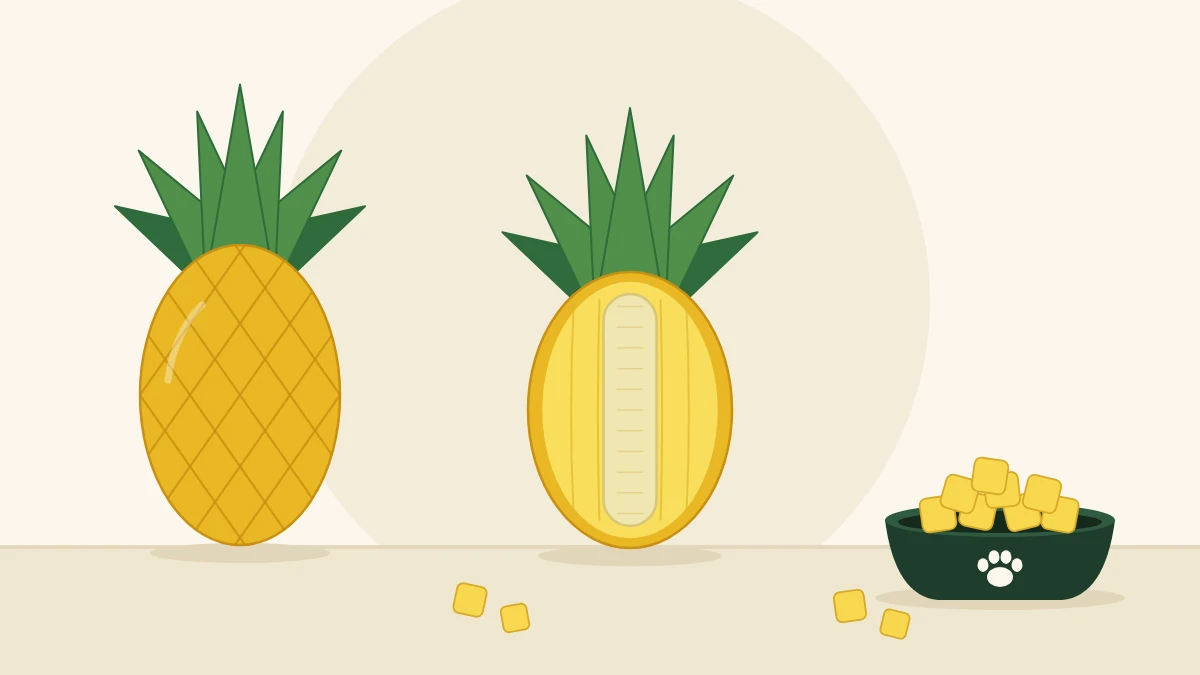
Can dogs eat pineapple: fresh pineapple cubes in a dog bowl beside a whole pineapple and a cut half.
Table of Contents
ToggleQuick Answer
Can dogs eat pineapple? Yes, in small amounts. Fresh, ripe pineapple flesh is a safe treat for most healthy dogs. Cut away the spiky skin, the tough core, and the crown, skip canned pineapple and sweetened products, and keep it occasional and within the 10% treat rule.
Quick Facts
| Verdict | What to know | |
|---|---|---|
| Fresh pineapple flesh | ✅ Safe | Small, bite-size pieces, a few at a time |
| Core | 🛑 No | Tough. A choking and blockage risk |
| Skin (rind) | 🛑 No | Spiny and hard to digest |
| Crown and leaves | 🛑 No | Sharp, fibrous, and not meant to be eaten |
| Canned pineapple | 🛑 No | Usually packed in sugary syrup |
| Dried pineapple | ⚠️ Caution | Concentrated sugar. Sources advise against store-bought |
| Pineapple juice | 🛑 No | Mostly sugar and acid |
| How often | Occasionally | A treat, not a meal |
You cut into a fresh pineapple on a warm afternoon, the whole kitchen smells like summer, and a dog appears out of nowhere with its eyes locked on the cutting board. It is a very common scene, and the question that follows is always the same: is this safe to share? The honest answer is mostly yes, with firm rules about the parts of the fruit your dog should never get. If you came here asking can dogs eat pineapple, here is everything that matters, from the core in the compost bin to the can in the pantry.
Is Pineapple Good for Dogs?
Can dogs eat pineapple as a healthy snack? It is a reasonable occasional treat, mostly because it is juicy, sweet, and most dogs love it. Veterinary writers cited by The Healthy list fiber, magnesium, manganese, potassium, iron, phosphorus, zinc, folate, and vitamins C and B-6 among its nutrients. Here is what raw pineapple contains per 100 grams, according to USDA FoodData Central:
| Per 100 g, raw | Pineapple |
|---|---|
| Calories | about 50 kcal |
| Water | about 86 g |
| Sugars | about 10 g |
| Fiber | about 1.4 g |
| Vitamin C | about 48 mg |
| Manganese | about 0.9 mg |
Health benefits, and a reality check
- Juicy and hydrating. Pineapple is mostly water, so a cube is a refreshing snack on a hot day.
- Some vitamins, minerals, and fiber. All are present, in modest amounts per bite.
- A strong flavor dogs tend to like. That makes it a fun, low-effort treat or training reward when it is cut small.
- Not a proven health food for dogs. The Healthy reports that there is little to no research showing that feeding dogs pineapple brings real health advantages.
Keep this in perspective. A dog eating a complete and balanced dog food is not short of vitamins or minerals, and pineapple is not a supplement. It also carries real sugar, which is why the portion matters more than the benefits.
Which Parts of a Pineapple Are Safe?
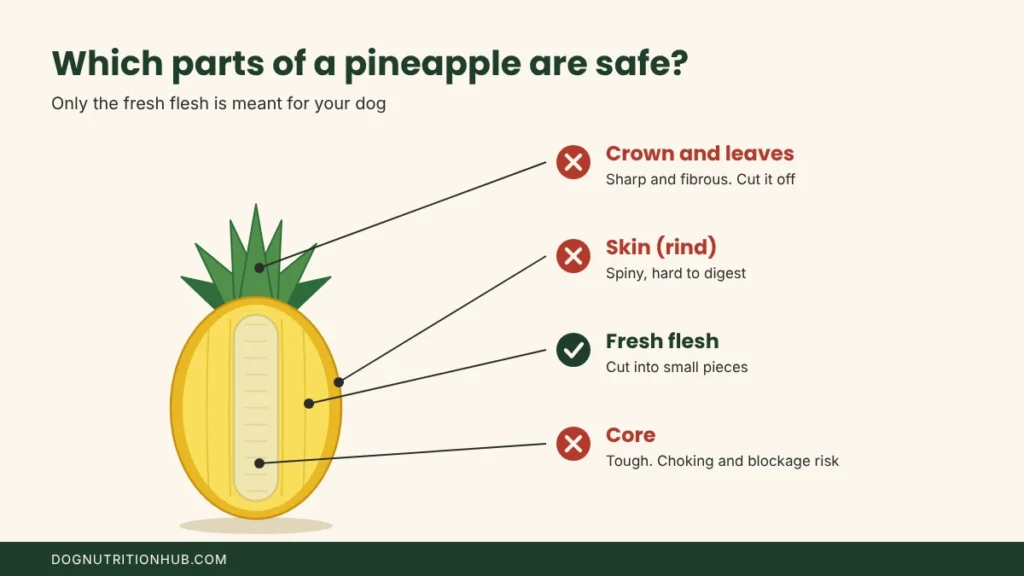
Can dogs eat pineapple the way it comes from the store? Not quite. Only one part of the fruit is meant for them.
Cross-section of a pineapple labeling the flesh as safe for dogs and the crown, skin, and core as parts to remove
Can Dogs Eat Pineapple Core and Skin?
Can dogs eat pineapple core and skin? No, and this is where nearly all real pineapple trouble starts. The danger is mechanical, not chemical. As WebVet puts it, the more serious risk is that swallowing the skin or core can lead to a choking incident or a blockage that may need veterinary care.
The core. It looks harmless once it is cut, but it is woody and hard to chew. PetMD says the core, rind, stem, and leaves are difficult to chew and digest, and that the core can create choking hazards or intestinal blockages. Its advice if your dog eats one is to contact your veterinarian immediately.
The skin. The rind is thick, spiny, and fibrous. The AKC says the spiny skin has the potential to cause obstructions, just like the core.
The crown. The leafy top is sharp and stiff. Purina groups the leaves with the skin and core as choking or obstruction risks. Cut it off before the fruit ever reaches the counter your dog can reach.
Why this matters more for some dogs. Dogs that gulp food without chewing are more likely to swallow a chunk whole, and small dogs have much less room in the throat and gut. A discarded pineapple top left in an open trash can is as much a risk as a piece you hand over.
Pineapple core and skin are not “poison.” Most of the time a small piece passes. But the cost of a blockage is high, and the benefit is zero, so remove them every time.
Can Dogs Eat Canned, Dried, Frozen, and Cooked Pineapple?
Can dogs eat pineapple in every form? No. This is where the verdict changes: the form matters more than the fruit.
Comparison of pineapple forms for dogs: fresh and plain frozen pieces as safer choices, canned in syrup, juice, and dried as forms to skip
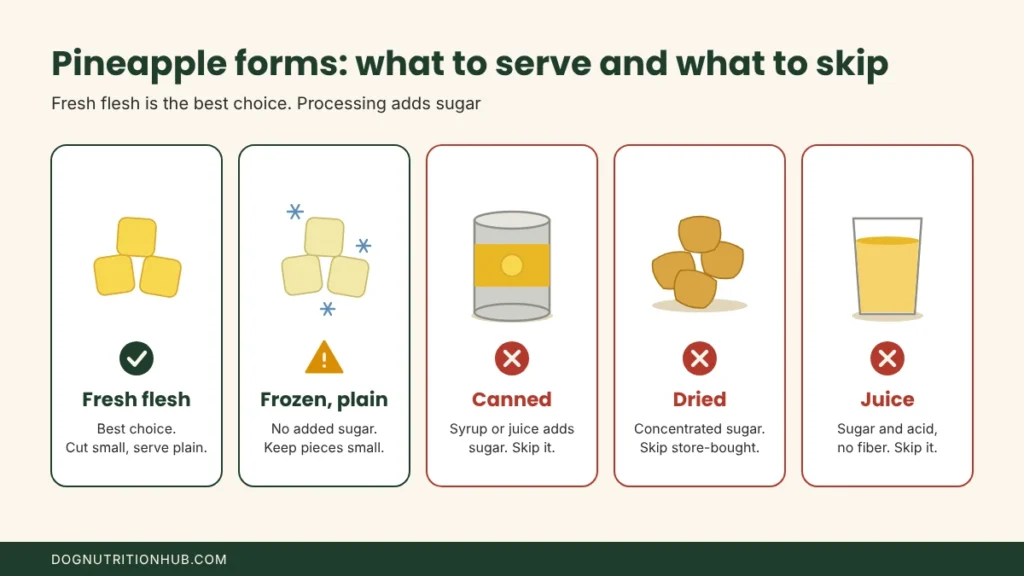
| Form | Verdict | Why |
|---|---|---|
| Fresh flesh | ✅ | Best choice, cut small |
| Frozen plain pieces | ⚠️ | Check the label for added sugar. Keep the pieces small |
| Cooked or grilled, plain | ⚠️ | Plain only. No sugar glaze, butter, or seasoning |
| Canned in syrup or juice | 🛑 | Added sugar on top of already sugary fruit |
| Dried, store-bought | 🛑 | Concentrated sugar and often additives |
| Pineapple juice | 🛑 | Sugar and acid with no fiber |
Canned pineapple. Can dogs eat canned pineapple? Every source we checked says to avoid it. The AKC says canned pineapple should be avoided because of added sugars. Purina explains the reason plainly: pineapple is already high in sugar, as is the juice in the can, and the two together are too much for your dog. PetMD also says canned pineapple is not recommended, and Chewy notes that too much sugar is a particular concern for senior dogs and those with diabetes or dental disease.
Dried pineapple. Can dogs eat dried pineapple? Purina says dried pineapple is not recommended as a treat. PetMD explains why: drying concentrates the natural sugars, and commercial dried fruit often contains added sugar, preservatives, or other ingredients that may be unsafe for dogs, so always check the label. Chewy takes a slightly softer line, saying to avoid store-bought dried pineapple but that a small amount of home-dehydrated fruit is possible in moderation. Our rule is simple: skip the bag from the store, and treat homemade dried pineapple as a rare extra, not a snack.
Frozen pineapple. Purina lists fresh or frozen pieces as preferable to canned. If you freeze plain, cut-up flesh at home, cold cubes are a pleasant treat on a hot day. Keep the pieces small, supervise your dog, and avoid store-bought frozen mixes with added sugar. If your dog is a fast gulper, serve it thawed.
Cooked or grilled pineapple. Plain flesh is fine in principle, but grilled pineapple from a barbecue often comes with sugar, glaze, butter, or marinade. If you want to share, set aside a plain piece before seasoning.
Pineapple juice. Chewy advises limiting high-sugar forms such as juice and dried fruit. Juice loses the fiber and concentrates the sugar, so skip it.
Is Pineapple Bad for Dogs?
Can dogs eat pineapple without any risk at all? For most healthy dogs, plain flesh in small amounts is not bad. The problems come from a short list of things.
Too much at once. The AKC says too much pineapple can cause digestive upset because of its sugar and fiber, and that a dog with diarrhea or an upset stomach may not be a good candidate for the fruit. WebVet adds that pineapple is not a true laxative, but its fiber, acid, and sugar can loosen a dog’s stool if they eat too much.
Sugar and calories. Pineapple is a sweet fruit. Chewy points out that because pineapple has so much sugar, you should start with a tiny, bite-size piece, and serve it only as an occasional treat. That matters most for dogs with diabetes or those on a weight plan.
The core, skin, and crown. Covered above. These are the avoidable risks.
Processed forms. Canned, dried, and juiced pineapple add sugar or concentrate it. These are the forms most likely to cause trouble.
Individual dislike. The Healthy reports that experts say unsweetened pineapple is not that appealing to most dogs, so few will eat enough to cause harm unless it has syrup or sweetener added. Some dogs turn their nose up, and that is fine. Never force it.
Mold. A pineapple left out too long can turn soft, leak, or ferment. Check before you share, and never feed fruit that is soft, leaking, or moldy.
Can Dogs Eat Pineapple Every Day?
Can dogs eat pineapple every day? It is better to keep it occasional. A healthy dog may handle a cube or two now and then, but there are good reasons to treat it as a snack and not a habit:
- Treats should not crowd out the main diet. Your dog’s food supplies what it needs.
- The sugar adds up. A cube is nothing. A bowlful every day is a lot of sugar for a small dog.
- Fiber and acid add up, too. Repeated pineapple is a common cause of a loose stool.
- The 10% guideline applies. Veterinary sources commonly advise that treats, including fruit, should make up no more than 10% of a dog’s daily calories. Pineapple counts toward that, along with biscuits and chews.
If your dog has diabetes, is overweight, or is on a weight management plan, ask your veterinarian before adding pineapple at all.
Can Dogs Have Pineapple? How Much Is Too Much
Can dogs have pineapple? Yes, as small flesh pieces, not as a bowl of fruit salad or a whole slice. Can a dog have some every time you cut one? No. A good starting point is simple:
- Start with one tiny piece. Offer a small cube and watch your dog for a day. If the stomach stays settled, it can be an occasional treat.
- Think “treat,” not “serving.” A few small cubes are a treat. A big helping is a meal’s worth of sugar for a small dog.
- Cut it to fit the dog. Purina advises keeping chunks small and notes that smaller pieces allow better portion control. It also warns about choking hazards for smaller breeds.
- Count it as calories. If you give pineapple regularly, adjust the rest of the day’s food and treats.
We do not give gram or cube counts here. We did not find a published, size-by-size serving table for pineapple from a source we could verify, and an invented number would only look precise. PetMD’s own guidance is to offer pineapple as an occasional treat in age-appropriate portions if your dog tolerates it well.
Can Small Dogs and Large Breeds Eat Pineapple?
The fruit does not change. Does size change the answer? No: a piece of fresh flesh is just as safe for a Chihuahua as for a Great Dane. What changes is how little of it counts as a portion, and how small the pieces must be.
Chart comparing pineapple portion guidance for toy and small, medium, and large and giant dog breeds, with relative amounts only
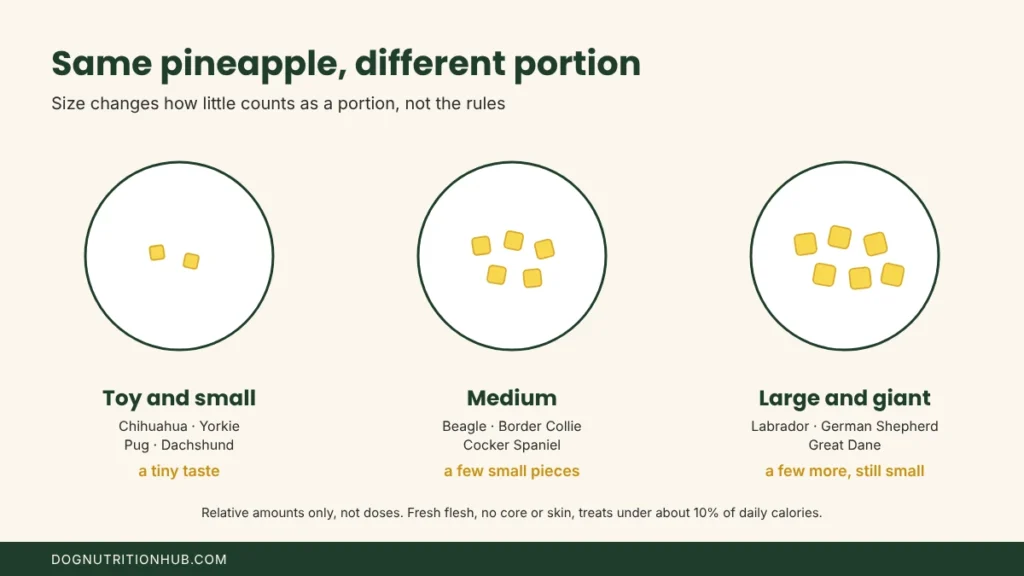
Chihuahuas and other tiny dogs. A tiny taste, cut very small, is plenty. A tiny dog can get an upset stomach from very little, and a chunk that is too big can become a choking hazard.
Small breeds. Pugs, Dachshunds, and Shih Tzus get a small taste at most. They gain weight easily, so treat even this as an occasional extra.
Medium dogs. Beagles and Cocker Spaniels can have a few small pieces at most. Both breeds are famous for eating anything, so keep the pineapple top and core out of reach.
Large and giant breeds. Labradors, German Shepherds, and Great Danes can have more, but more is not better. A big dog can still get loose stools from too much fruit, and a big dog can swallow a core whole.
Active and working breeds. Border Collies and Australian Shepherds burn more calories, but that does not make pineapple a free food. Extra energy needs are better met by adjusting main meals than by adding treats.
Breeds with a wide weight range. Poodles and Spaniels vary a lot within the same breed name. Go by your dog’s actual weight, not the breed label.
Puppies. PetMD says that if a puppy tolerates the fruit well, pineapple can occasionally be offered as a treat in age-appropriate portions. Start with a tiny piece of flesh, watch for a stomach upset, and ask your veterinarian before making fruit a regular part of a puppy’s diet.
Size changes the portion, not the form. Canned pineapple, juice, and dried fruit are off the menu for every dog at every weight, and a large dog does not get a pass on them.
If your dog has diabetes or is on a weight management plan, ask your veterinarian regardless of breed or size.
📥 Get the Safe & Toxic Foods Chart (free PDF)
A one-page quick reference for the foods to share, the foods to limit, and the ones to avoid. Enter your email and we’ll send it straight away.
Does Pineapple Stop Dogs From Eating Poop?
This is one of the most searched questions about the fruit, so it deserves a straight answer. Does pineapple stop dogs from eating poop? Probably not. The idea is that pineapple makes the stool taste bad. Purina’s own coprophagia guide mentions it as something owners try, but says there is no scientific evidence to support it and that people who recommend it do so anecdotally.
Veterinary experts quoted by The Healthy say the same. There is some anecdotal evidence, but there have not been studies to back it up. Karen Overall, VMD, adds that even if pineapple did make the stool taste worse, it is unlikely to stop a dog from eating it, because bad-tasting or digested substances do not deter dogs. Live Science reports on a 2018 study by researcher Bain that tested 11 food additives marketed to stop the habit and found their effectiveness ranged from zero to 2%. It also notes that there is no evidence home remedies such as pineapple work for most dogs.
What does help? Understanding why dogs do it. Live Science describes poop-eating, or coprophagia, as a natural behavior, and a 2018 survey of about 1,400 US dog owners found that 23% of dogs had eaten poop at least once and 16% did it often. The UK charity PDSA says many dogs do it out of habit, boredom, hunger, or because they like the taste, and that it is very rarely caused by a medical problem. Purina advises restricting access, which means picking up promptly, and consulting a veterinarian or animal behaviorist if the habit continues or happens when the dog is left alone.
Pineapple is not harmful as a test if you follow the usual rules, but do not count on it, and do not use it as a reason to feed more than a small amount. If your dog is eating stool and seems unwell, call your veterinarian.
Fruit Salad, Pineapple Pizza, and Other Mixed Dishes
Pineapple rarely shows up alone. Is the fruit still fine when it is part of a dish? That depends entirely on what else is in it.
- Fruit salad. Pineapple chunks are often mixed with grapes, and sometimes raisins. Grapes and raisins are toxic to dogs, so never share a mixed fruit salad. Pull out a plain piece of pineapple before the salad is assembled.
- Pineapple on pizza. The fruit is not the problem. The cheese, sauce, dough, ham, and often onion and garlic are. Onion and garlic are harmful to dogs, so do not share pizza at all.
- Smoothies and yogurt bowls. Check the ingredients for sweeteners, including xylitol, and for other fruit that may not be safe.
- Pineapple upside-down cake, tarts, and baked goods. Sugar, butter, and often cherries or other add-ins. Skip them.
- Tropical drinks and mocktails. Sugar, and sometimes alcohol or coconut cream. Keep these away from dogs.
- Cottage cheese with pineapple. The pineapple follows the same rules: fresh, plain, small pieces. Check the cottage cheese separately, since it adds dairy and salt, and ask your veterinarian if your dog has a sensitive stomach.
Pineapple Products to Skip
The fruit is safe. Many things made from it are not. Fresh, plain flesh is simple, but pineapple appears in many forms, and each one adds something your dog does not need.
- Canned pineapple in syrup or juice. Added sugar on top of already sweet fruit. The AKC, Purina, and PetMD all advise against it.
- Pineapple juice. High in sugar, with no fiber.
- Dried or candied pineapple. Concentrated sugar, often with added sugar or preservatives.
- Pineapple-flavored drinks, candy, and gummies. Flavorings and sweeteners, possibly including xylitol. If the label lists xylitol, skip it entirely, because xylitol is poisonous to dogs. Read our guide on xylitol poisoning in dogs.
- Pineapple jam, sauce, and glazes. Sugar, and sometimes spices or onion.
- Pineapple tops and cores kept for composting or replanting. Keep them in a closed bin your dog cannot reach.
Can dogs eat pineapple in these forms? No. The pattern runs through all of them. Fresh, plain fruit is the safe choice, and processing adds sugar or sweeteners that change the verdict. Our guide to processed foods for dogs explains why.
What If My Dog Ate Too Much Pineapple?
If it was plain, fresh flesh. Is a big helping usually trouble-free? Not usually. The common result is a mild stomach upset: gas, loose stools, vomiting, or diarrhea. Skip the fruit, keep fresh water available, and watch your dog. If the upset is severe, keeps getting worse, or does not settle, call your veterinarian.
If your dog ate the core, skin, or crown. PetMD’s advice for the core is to contact your veterinarian immediately. A very small piece may pass without trouble, but a large piece, a whole core, or any amount in a small dog is a reason to call, even if your dog seems fine, because a blockage can develop later. Call right away if your dog is retching without bringing anything up, vomiting repeatedly, has a swollen or painful belly, strains to pass stool, or stops eating.
If it was canned pineapple or something sweetened. One taste is usually a stomach upset at worst. Check the label for xylitol. If xylitol is listed, or you cannot tell, call your veterinarian or a pet poison hotline immediately.
If it was fruit salad. Check whether it contained grapes or raisins. If it did, call your veterinarian or a pet poison hotline right away; do not wait for symptoms.
If it was moldy fruit. Treat this as more serious. Mold can produce toxins that affect the nervous system. Contact your veterinarian or a pet poison hotline right away.
How to Prepare and Serve Pineapple for Dogs
Can dogs eat pineapple straight from the cutting board? Almost. A few minutes of preparation makes it dog-ready.
Five-step guide to preparing pineapple for dogs: choose, cut off the crown and skin, remove the core, cut into small pieces, serve plain
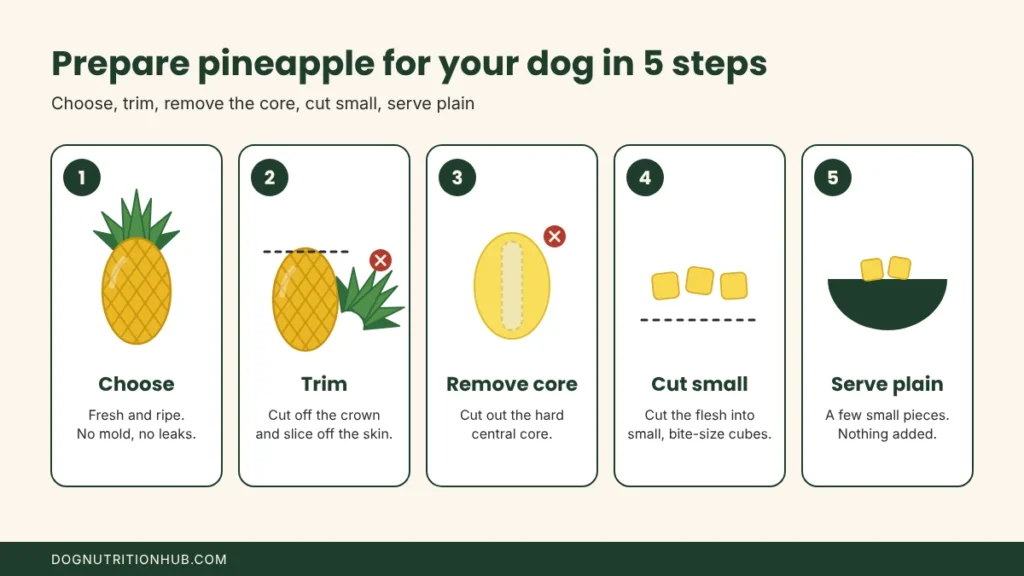
- Choose a fresh, ripe pineapple. Skip any that are soft, leaking, moldy, or smell fermented.
- Cut off the crown and the base. Throw the top away where your dog cannot reach it.
- Slice off the skin completely. Take off all the spiny rind and any brown “eyes.”
- Cut out the core. Remove the hard central column.
- Cut the flesh into small, bite-size cubes, and smaller for small dogs.
- Serve it plain. No sugar, honey, syrup, or seasoning.
- Store leftovers in the fridge. Throw them out if they turn soft or smell fermented.
Serving ideas:
- A few small cubes as a treat or training reward
- Chilled cubes on a warm day
- Frozen plain pieces. Keep them small and supervise your dog
- A tiny piece pressed into a puzzle toy or lick mat
When to Call Your Veterinarian Right Away
Contact your veterinarian, an emergency clinic, or a pet poison hotline promptly if your dog:
- Ate the core, a piece of skin, or the crown, especially a small dog
- Is retching, has a swollen or painful belly, strains to pass stool, or stops eating
- Drank or ate something sweetened that may contain xylitol
- Ate fruit salad that may have contained grapes or raisins
- Ate moldy fruit
- Has repeated vomiting or diarrhea that does not settle
- Shows weakness, tremors, trouble breathing, or collapse
- Has a medical condition such as diabetes and ate a large amount
Is pineapple safe for a dog with a medical condition? Sometimes, but ask first. If you are in the US, ASPCA Animal Poison Control and the Pet Poison Helpline both offer round-the-clock advice; a consultation fee usually applies. When in doubt, call: it is always better to ask early.
Myth vs Fact
Myth: Pineapple stops dogs from eating poop.
Fact: It is only an anecdote. Purina says there is no scientific evidence for it, and experts quoted by The Healthy say it is unlikely to deter a dog.
Myth: If the flesh is safe, the whole pineapple is safe.
Fact: The core, skin, and crown are choking and blockage risks. Only the flesh is for dogs.
Myth: Canned pineapple is just as good as fresh.
Fact: The AKC, Purina, and PetMD all advise against it because of added sugar.
Myth: Pineapple is a natural laxative for dogs.
Fact: WebVet says it is not a true laxative, but its fiber, acid, and sugar can loosen the stool if a dog eats too much.
Myth: Pineapple is poison for dogs.
Fact: The flesh is not toxic. It is the hard parts, too much, and sweetened products that cause problems.
FAQ
Can puppies eat pineapple?
Can dogs eat pineapple as puppies? PetMD says that if a puppy tolerates the fruit well, it can occasionally be offered as a treat in age-appropriate portions. Start with a tiny piece of flesh, watch for stomach upset, and ask your veterinarian before making it a regular treat.
Can dogs eat pineapple core?
No. The core is tough and can cause choking or an intestinal blockage. PetMD says to contact your veterinarian immediately if your dog eats it.
Can dogs eat pineapple skin?
No. The AKC says the spiny skin can cause obstructions. Cut it away completely and keep it out of reach.
Can dogs eat canned pineapple?
No. The AKC, Purina, and PetMD all advise against it, mainly because of the added sugar in the syrup or juice.
Can dogs eat dried pineapple?
It is better to skip it. Purina says dried pineapple is not recommended, and PetMD notes that drying concentrates the sugar and that commercial products often contain additives. Fresh flesh is the better choice.
Can dogs eat frozen pineapple?
Purina lists fresh or frozen pieces as preferable to canned. Freeze plain, cut-up flesh, keep the pieces small, and supervise your dog. Avoid frozen mixes with added sugar.
Can dogs eat pineapple every day?
It is best to keep it occasional. Treats should stay within about 10% of daily calories, and daily pineapple is more likely to bring on a loose stool.
Can dogs eat pineapple if they have diabetes or are overweight?
It is safest to ask your veterinarian first. Pineapple is a sweet fruit, and Chewy notes that sugar is a particular concern for dogs with diabetes.
Can dogs eat pineapple with cottage cheese?
The pineapple follows the same rules: fresh, plain, and cut small. The cottage cheese is a separate food, so check it for added salt or sweeteners, and ask your veterinarian if your dog has a sensitive stomach.
The Bottom Line
So, can dogs eat pineapple? Yes. Plain, fresh, ripe pineapple flesh is a safe and refreshing treat for dogs of every size when served in small amounts. The core, skin, and crown should stay out of the bowl, along with canned pineapple, juice, dried fruit, and sweetened products. Keep the count small, keep it occasional, and cut the pieces to fit your dog. If your dog has a health condition such as diabetes, ask your veterinarian first, and if your dog swallows the core or skin, call your veterinarian right away.
References
- American Kennel Club (AKC). “Can Dogs Eat Pineapple?”
- Purina. “Can Dogs Eat Pineapple?
- PetMD. “Can Dogs Eat Pineapple?”
- WebVet. “Can Dogs Eat Pineapple?”
- Chewy. “Can Dogs Eat Pineapple?”
- The Healthy (Reader’s Digest). “Can Dogs Eat Pineapple?
- Live Science. “Why do dogs eat poop?”
- PDSA. “Coprophagia in dogs” (habit, boredom, hunger; rarely medical).
Disclaimer
Written by the Dog Nutrition Hub Editorial Team and fact-checked against published veterinary and nutritional sources. It has not been reviewed by a veterinarian. This article is for general educational purposes only and is not a substitute for professional veterinary advice, diagnosis, or treatment. Always consult a licensed veterinarian about your dog’s health. See our Medical Disclaimer.
Last updated: November 17, 2026