Can dogs eat oranges: peeled orange segments in a dog bowl beside whole and halved oranges with leaves
Table of Contents
ToggleQuick Answer
Can dogs eat oranges? Yes, in small amounts. The peeled, seedless flesh is a safe treat for most healthy dogs. Take off the peel, the white pith, and any seeds, skip juice and sweetened orange products, and keep it occasional and within the 10% treat rule.
Quick Facts
| Verdict | What to know | |
|---|---|---|
| Peeled orange segments | ✅ Safe | One or two at a time, no more |
| Peel | 🛑 No | Hard to digest, and its oils can upset the stomach |
| White pith | ⚠️ Caution | Tough to digest. Pull off what you can |
| Seeds | ⚠️ Caution | Remove them. A choking risk for small dogs |
| Orange juice | 🛑 No | Not toxic, but very sugary and acidic |
| Blood, Cara Cara, and navel oranges | ✅ Safe | Same rules as any orange |
| Lemons, limes, grapefruit | 🛑 No | Too acidic, and their oils are a problem |
| How often | Occasionally | A treat, not a meal |
You peel an orange, and within seconds a dog is at your knee, nose working, eyes fixed on the fruit. It is one of the most common snack-time scenes in any home with a dog, and the question that follows is always the same: is this safe to share? The honest answer is mostly yes, with a few firm rules about the parts your dog should never get. If you came here wondering can dogs eat oranges, here is everything that matters, from the peel on the counter to the juice in the glass.
Are Oranges Good for Dogs?
Can dogs eat oranges as a healthy snack? They are a reasonable occasional treat, mostly because they are juicy and fairly low in calories per segment. The American Kennel Club (AKC) notes that oranges provide vitamin C, fiber, and potassium. Here is what raw oranges contain per 100 grams, according to USDA FoodData Central:
| Per 100 g, raw | Oranges |
|---|---|
| Calories | about 47 kcal |
| Water | about 87 g |
| Sugars | about 9 g |
| Fiber | about 2 g |
| Vitamin C | about 53 mg |
| Potassium | about 181 mg |
Health benefits, and a reality check
- Juicy and hydrating. Oranges are mostly water, so a segment is a refreshing snack on a warm day.
- Some vitamin C, fiber, and potassium. All three are present, in modest amounts.
- Easy to portion. An orange comes pre-divided into segments, which makes one piece simple to hand out.
- Plant compounds. Citrus contains flavonoids and other compounds studied in people. A few segments are not shown to do anything special for your dog, so we do not claim a benefit.
Keep this in perspective. A dog eating a complete and balanced dog food is not short of vitamin C, and dogs make their own. Orange segments are a snack, not a supplement. They also carry real sugar and acid, which is why the portion matters more than the benefits.
Which Parts of an Orange Are Safe?
Can dogs eat oranges the way they come out of the fruit bowl? Not quite. Only one part of the fruit is meant for them.
Cross-section of an orange labeling the segments as safe for dogs and the peel, white pith, and seeds as parts to remove
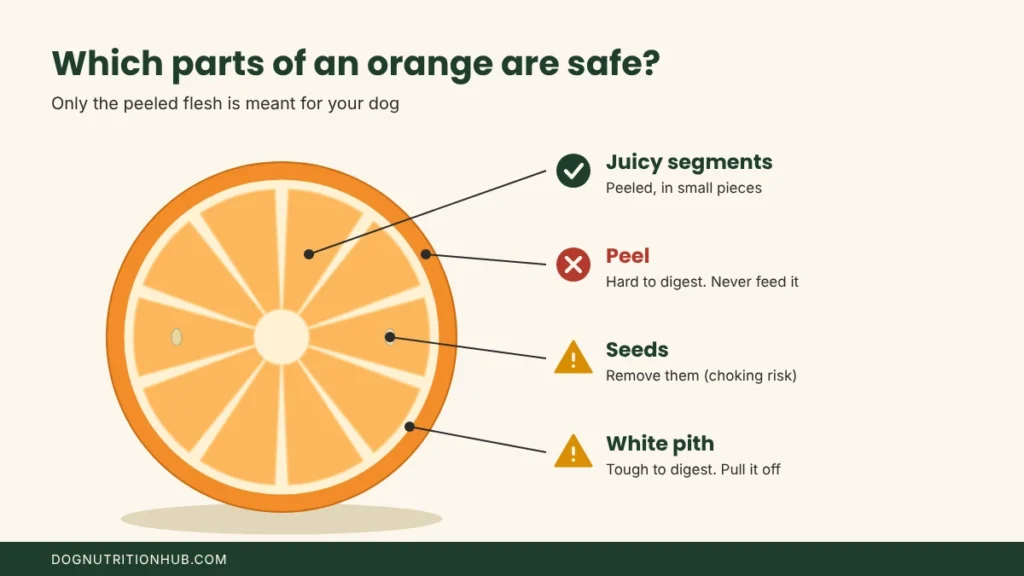
| Part | Verdict | Why |
|---|---|---|
| Juicy segments (flesh) | ✅ | The part meant for eating |
| Peel (skin) | 🛑 | PetMD says peels are tough to digest and can cause intestinal blockages. The oils may irritate the stomach |
| White pith | ⚠️ | Harder to digest, and can upset the stomach |
| Seeds | ⚠️ | The AKC lists them as a choking hazard. Remove them |
| Leaves, stems, and bark from a tree | 🛑 | ASPCA names essential oils and psoralens in citrus plant material |
Can Dogs Eat Orange Peels?
Can dogs eat oranges with the peel on? No, and this is where most orange trouble starts. A peel is easy to leave on a counter, drop on the floor, or toss in an open trash can, and some dogs will eat anything within reach. The AKC points out that dogs that gulp their food without chewing are at even greater risk, and it advises keeping discarded peels out of reach.
Are orange peels toxic to dogs? They are not a classic poison, but they carry two separate problems:
- The oils. The ASPCA’s entry for the orange plant names essential oils and psoralens as the toxic principles. It says the fruit is edible, but skins and plant material can cause problems. Signs it lists include vomiting, diarrhea, and depression, and possibly skin irritation. PetMD adds that the oils may irritate the stomach.
- The texture. PetMD and the AKC both say the peel is tough to digest. A chunk of rubbery peel is more of a worry for a small dog than the oil is, because of the blockage risk.
One small bite of peel usually means a stomach upset at worst. But never offer it on purpose, and do not treat orange zest or dried peel as a flavoring for your dog. Put peels straight into a closed bin.
Are Oranges Bad for Dogs?
Can dogs eat oranges without any risk at all? For most healthy dogs, plain peeled segments are not bad. The problems come from a short list of things.
Too many at once. Oranges are sweet and acidic. The AKC says too much can cause digestive upset because of the sugar and acidity. Gas, vomiting, or diarrhea are the usual results, especially in dogs with sensitive stomachs.
Sugar and calories. PetMD describes oranges as relatively high in sugar. That adds calories, and it matters for dogs with diabetes. PetMD says not to feed oranges to dogs that are overweight or have been diagnosed with diabetes.
The peel, pith, and seeds. Covered above. These are the avoidable risks.
Mold. An orange that has sat too long can turn soft and moldy. Check before you share, and never feed one that is soft, leaking, or moldy.
Individual dislike. The AKC notes that not all dogs enjoy the tart taste or strong smell of citrus. Some turn their nose up, and that is fine. Never force it.
Are the seeds a problem?
Can dogs eat oranges with seeds still inside? Navel oranges usually have none, but some other types contain a few. The AKC says seeds can be a choking hazard, and PetMD lists them among the parts to remove. Take them out, and the question goes away.
Can Dogs Eat Oranges Every Day?
Can dogs eat oranges every day? It is better to keep them occasional. A healthy dog may handle a segment now and then, but there are good reasons to treat it as a snack and not a habit:
- Treats should not crowd out the main diet. Your dog’s food supplies what it needs.
- The sugar adds up. A segment is nothing. A whole orange every day is a lot for a small dog.
- The acid adds up too. Repeated citrus is a classic cause of a loose stool.
- The 10% rule applies. PetMD and the AKC say treats, including fruit, should make up no more than 10% of a dog’s daily calories. Oranges count toward that, along with biscuits and chews.
PetMD’s serving table also sets a pace: no more than once or twice a week. If your dog has diabetes or is on a weight management plan, ask your veterinarian before adding oranges at all.
Can Dogs Have Oranges? How Much Is Too Much
Can dogs have oranges? Yes, as segments, not as a whole fruit. Can a dog have an orange every time you peel one? No. A good starting point is simple:
- Start with one small piece. Offer a tiny bit of a segment and watch your dog for a day. If the stomach stays settled, it can be an occasional treat.
- Think “treat,” not “serving.” One segment is a treat. A whole orange is a meal’s worth of sugar for a small dog.
- Cut it to fit the dog. Break segments into smaller pieces for small dogs.
- Count it as calories. If you give oranges regularly, adjust the rest of the day’s food and treats.
Can Small Dogs and Large Breeds Eat Oranges?
The fruit doesn’t change. Does size change the answer? No: a peeled segment is just as safe for a Chihuahua as for a Great Dane. What changes is how little of it counts as a portion.

Chart comparing orange segment portions for toy and small, medium, and large and giant dog breeds
PetMD publishes a serving table by weight, and it is the most useful starting point we have found. These are upper limits for a healthy dog, offered once or twice a week, not targets:
| Dog size (PetMD) | Example breeds | Serving |
|---|---|---|
| Extra-small (2-10 lb) | Chihuahua, Yorkie, Pomeranian | ½ segment |
| Small (11-20 lb) | Pug, Dachshund, Shih Tzu | 1 segment |
| Medium (21-50 lb) | Beagle, Border Collie, Cocker Spaniel | 1½ segments |
| Large (51-90 lb) | Labrador, German Shepherd, Golden Retriever | 2 segments |
| Extra-large (91+ lb) | Great Dane, Mastiff, Saint Bernard | 2½ segments |
Chihuahuas and other tiny dogs. Half a segment, cut into small pieces, is plenty. A tiny dog can get a stomach upset from very little, and one whole segment can already be too much.
Small breeds. One segment, broken up, is the ceiling. Pugs and Dachshunds gain weight easily, so treat even this as an occasional extra.
Medium dogs. Beagles and Cocker Spaniels can have a segment and a half at most. Beagles and Cocker Spaniels are famous for eating anything, so keep the oranges out of reach.
Large and giant breeds. Labradors, German Shepherds, and Great Danes can have a couple of segments. A big dog can still get loose stools from too much citrus, so more is not better.
Active and working breeds. Border Collies and Australian Shepherds burn more calories, but that doesn’t make oranges a free food. Extra energy needs are better met by adjusting main meals than by adding treats.
Breeds with a wide weight range. Poodles and Spaniels vary a lot within the same breed name. Go by your dog’s actual weight, not the breed label.
Puppies. PetMD says puppies can eat oranges, but they are more prone to upset stomachs and more sensitive to acid, so offer only a tiny piece at first, with the peel and seeds removed. Ask your veterinarian before making fruit a regular part of a puppy’s diet.
Size changes the portion, not the form. Orange juice and sweetened orange products are off the menu for every dog at every weight, and a large dog does not get a pass on them.
If your dog has diabetes or is on a weight management plan, ask your veterinarian regardless of breed or size.
📥 Get the Safe & Toxic Foods Chart (free PDF)
A one-page quick reference for the foods to share, the foods to limit, and the ones to avoid. Enter your email and we’ll send it straight away
Can Dogs Eat Blood Oranges, Cara Cara, and Sumo Oranges?
Oranges now come in a dozen colors and shapes, and the grocery aisle in winter makes that obvious. Can dogs eat blood oranges, Cara Cara oranges, or Sumo oranges? Yes. The same rules apply to all of them: flesh only, no peel, no pith, no seeds, small amounts.
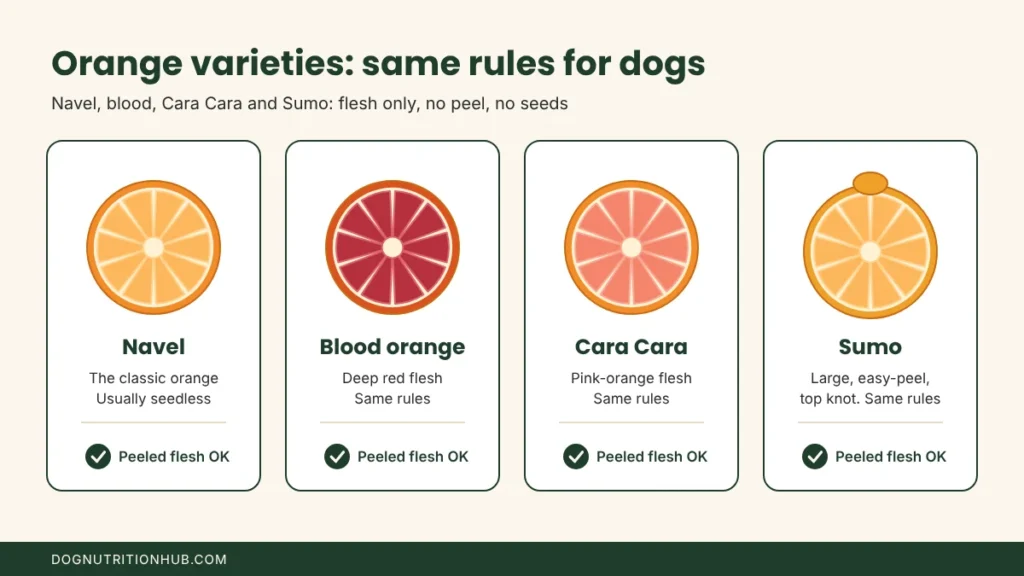
Four orange varieties: navel, blood, Cara Cara, and Sumo, all following the same rules for dogs
| Variety | What it looks like | For your dog |
|---|---|---|
| Navel | The classic: bright orange flesh, usually seedless | Peeled segments in small amounts |
| Blood orange | Deep red or burgundy flesh | Same rules. Expect stained fingers and a messy muzzle |
| Cara Cara | A navel type with pink-orange flesh | Same rules |
| Sumo | A large, easy-peel, mandarin-type citrus with a top knot | Same rules, and the same peel warning |
Can dogs eat blood oranges? The deep color comes from natural plant pigments in the flesh, and the fruit is handled like any other orange. The only difference you will notice is the mess. The name and color on the label do not change the verdict. The form does: the peeled flesh is the part for your dog, whatever the variety.
Can Dogs Eat Oranges or Tangerines?
Many owners ask about the whole citrus family at once. Can dogs eat oranges or tangerines? Both, using the same rules. PetMD lists ripe oranges, tangerines, and clementines as acceptable in moderation: peel off, seeds out, small amounts.
Mandarins, tangerines, clementines, satsumas, and Cuties are all easy-peel fruits in the mandarin group, and they have their own full guide, including how the peel and pith differ and a size-by-size breakdown. If that is the fruit in your hand, read our guide to Can Dogs Eat Mandarin Oranges?.
Can Dogs Eat Lemons, Limes, and Grapefruit?
Do the same rules cover the rest of the citrus aisle? No. This is where oranges stand apart. PetMD says grapefruit, lemons, and limes are too acidic and can irritate your dog’s stomach, and the ASPCA lists the essential oils and psoralens in these fruits as toxic principles. Most dogs dislike the taste anyway.
The simple rule: oranges, tangerines, and clementines can be an occasional treat, peeled. Lemons, limes, and grapefruit should not be offered at all. A lick of lemonade from a spilled glass is not an emergency, but do not make it a habit.
Orange Products to Skip
The fruit is safe. Many things made from it are not. Plain peeled segments are simple, but oranges show up in many forms, and each one adds something your dog does not need.
- Orange juice. PetMD says orange juice is non-toxic but not recommended as a treat, because it is high in sugar and very acidic. Juice also loses the fiber and concentrates the sugar. Can dogs drink orange juice? Better not.
- Canned mandarin or orange segments in syrup. Syrup turns a snack into a sugar-heavy treat. PetMD recommends plain, fresh fruit over processed products, which often contain added sugar or artificial ingredients.
- Orange-flavored drinks and candy. Flavorings and sweeteners, possibly including xylitol. If the label lists xylitol, skip it entirely, because xylitol is poisonous to dogs. Read our guide on xylitol poisoning in dogs.
- Dried or candied orange slices and peel. Drying concentrates the sugar, and candied peel is mostly sugar.
- Marmalade, jam, and orange cake. Sugar, and sometimes butter, raisins, or chocolate.
- Orange essential oils and cleaning sprays. Concentrated citrus oils are not food. Keep them off your dog and out of reach.
Can dogs eat oranges in these forms? No. The pattern runs through all of them. Fresh, plain fruit is the safe choice, and processing adds sugar or sweeteners that change the verdict. Our guide to processed foods for dogs explains why.
What If My Dog Ate Too Many Oranges?
If it was plain, peeled segments. Is a big helping usually trouble-free? Not usually. The common result is a mild stomach upset: gas, loose stools, vomiting, or diarrhea. Skip the fruit, keep fresh water available, and watch your dog. If the upset is severe, keeps getting worse, or does not settle, call your veterinarian.
If your dog ate a piece of peel. A small piece usually means, at worst, an upset stomach. A large amount of peel, a whole peel, or any peel in a small dog is a reason to call your veterinarian, even if your dog seems fine, because of the blockage risk. Call right away if your dog is retching without bringing anything up, has a swollen or painful belly, or stops eating.
If it was juice or anything sweetened. Check the label for xylitol. If xylitol is listed, or you cannot tell, call your veterinarian or a pet poison hotline immediately.
If it was moldy fruit. Treat this as more serious. Mold can produce toxins that affect the nervous system. Contact your veterinarian or a pet poison hotline right away; do not wait for symptoms to appear.
How to Prepare and Serve Oranges for Dogs
Can dogs eat oranges straight from the fruit bowl? Almost. A minute of preparation makes them dog-ready.
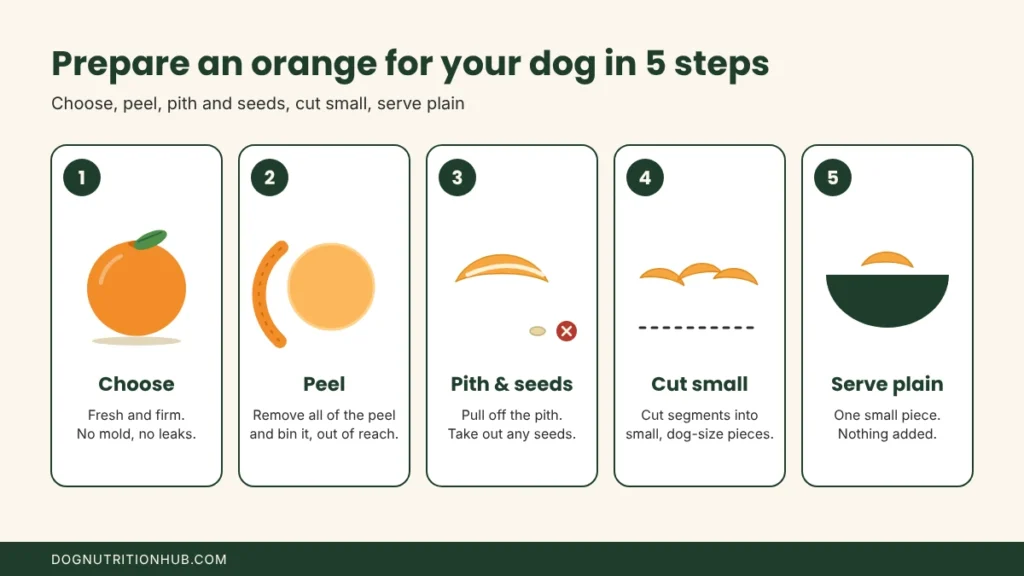
Five-step guide to preparing an orange for dogs: choose, peel, pull off the pith, cut into pieces, serve plain
- Choose a fresh, firm orange. Skip any that are soft, leaking, moldy, or smell fermented.
- Peel it completely, and throw the peel away where your dog cannot reach it.
- Pull off the white pith and stringy membranes as much as you can.
- Take out any seeds.
- Break off a segment, and cut it smaller for small dogs.
- Serve it plain. No sugar, honey, syrup, or seasoning.
- Store leftovers in the fridge. Throw them out if they turn soft or moldy.
Serving ideas:
- A single segment as a treat or training reward
- Chilled segments on a warm day
- Frozen pieces. Small pieces are fine; supervise your dog and keep them small enough not to be a choking risk
- A small piece pressed into a puzzle toy or lick mat
When to Call Your Veterinarian Right Away
Contact your veterinarian, an emergency clinic, or a pet poison hotline promptly if your dog:
- Ate a large amount of peel, or any peel and is a small dog
- Is retching, has a swollen or painful belly, or stops eating
- Drank or ate something sweetened that may contain xylitol
- Ate moldy fruit
- Has repeated vomiting or diarrhea that does not settle
- Shows weakness, tremors, trouble breathing, or collapse
- Has a medical condition such as diabetes and ate a large amount
Is an orange safe for a dog with a medical condition? Sometimes, but ask first. If you are in the US, ASPCA Animal Poison Control and the Pet Poison Helpline both offer round-the-clock advice; a consultation fee usually applies. When in doubt, call: it is always better to ask early.
Myth vs Fact
Myth: Because oranges are full of vitamin C, a dog needs them.
Fact: Dogs make their own vitamin C. A dog on a complete and balanced diet does not need oranges.
Myth: The peel is the healthiest part, so a little is good for dogs.
Fact: The peel is the part to avoid. It is tough to digest, and its oils can upset the stomach.
Myth: Orange juice is the same as the fruit.
Fact: Juice is non-toxic but high in sugar and very acidic, and PetMD does not recommend it as a treat.
Myth: All citrus is the same for dogs.
Fact: Peeled oranges, tangerines, and clementines can be an occasional treat. Lemons, limes, and grapefruit are too acidic and should not be offered.
Myth: Oranges are poison for dogs.
Fact: The fruit is not toxic. It is the peel, the plant material, too much, and sweetened products that cause problems.
FAQ
Can puppies eat oranges?
Can dogs eat oranges as puppies? Puppies can usually have a tiny piece of a peeled segment, but they are more prone to upset stomachs and more sensitive to acid. Offer a very small amount, watch for stomach upset, and ask your veterinarian before making it a regular treat.
Can dogs eat oranges with the peel on?
No. The peel is hard to digest, can cause a blockage, and its oils can upset the stomach. Peel the fruit completely, and keep the peel out of reach.
Can dogs eat oranges safely every day?
It is best to keep them occasional. PetMD’s serving table is once or twice a week, and treats should stay within 10% of daily calories. Daily citrus is more likely to bring on a loose stool.
Can dogs drink orange juice?
It is better to skip it. Orange juice is not toxic, but it is high in sugar and very acidic, and PetMD does not recommend it as a treat. Fresh peeled segments are the better choice.
Can dogs eat oranges if they have diabetes or are overweight?
PetMD says not to feed oranges to dogs that are overweight or have been diagnosed with diabetes, because of the sugar. Ask your veterinarian before offering any fruit.
Can dogs eat oranges if they have a sensitive stomach?
It is safest to skip them, or to offer only a tiny piece, because citrus is acidic and can bring on vomiting or diarrhea. If your dog has had stomach trouble recently, ask your veterinarian before offering any new food.
Are dogs allergic to oranges?
Food allergies in dogs most often involve proteins in the main diet, and fruit allergies are uncommon. Still, any new food can cause a reaction. If your dog gets itchy, develops hives or swelling, or has repeated vomiting or diarrhea after a segment, stop and call your veterinarian. Facial swelling or trouble breathing is an emergency.
Are oranges and mandarins the same for dogs?
The rules are the same: flesh only, small amounts. Mandarins have their own guide with the details: Can Dogs Eat Mandarin Oranges?
The Bottom Line
So, can dogs eat oranges? Yes. Plain, peeled, seedless orange segments are a safe and refreshing treat for dogs of every size when served in small amounts. Blood oranges, Cara Cara oranges, and Sumo oranges follow the same rules. The peel, the pith, the seeds, juice, and sweetened products should stay off the menu, and so should lemons, limes, and grapefruit. Keep the count small, keep it occasional, and adjust for your dog’s size. If your dog has a health condition such as diabetes, ask your veterinarian first
References
- USDA FoodData Central.
- PetMD. “Can Dogs Eat Oranges?”
- American Kennel Club (AKC). “Can Dogs Eat Oranges?”
- ASPCA.
- Pet Poison Helpline.
Disclaimer
Written by the Dog Nutrition Hub Editorial Team and fact-checked against published veterinary and nutritional sources. It has not been reviewed by a veterinarian. This article is for general educational purposes only and is not a substitute for professional veterinary advice, diagnosis, or treatment. Always consult a licensed veterinarian about your dog’s health. See our Medical Disclaimer.
Last updated: November 15, 2026