Table of Contents
ToggleQuick Answer
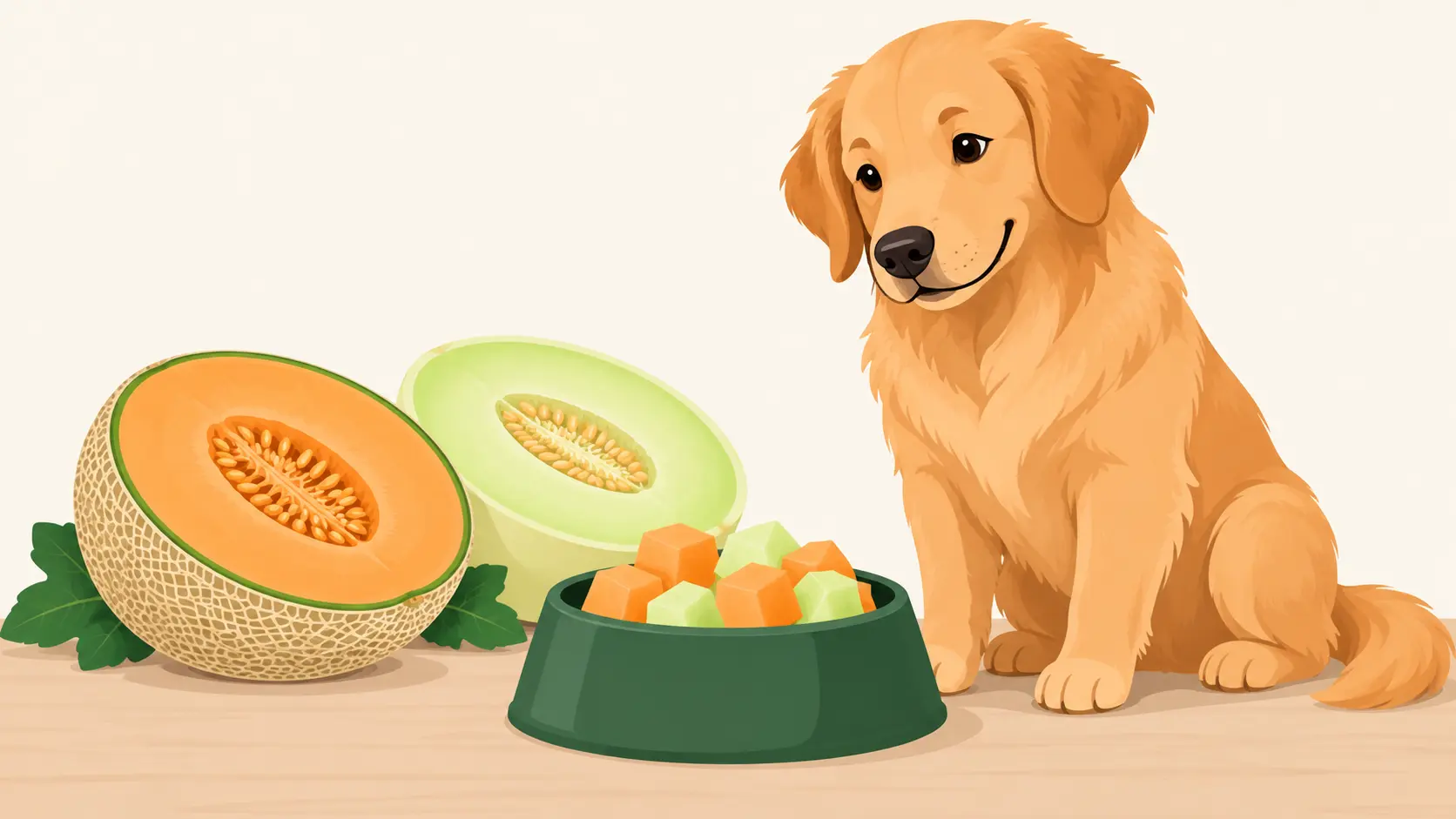
Can dogs eat cantaloupe? Yes, in moderation. The ripe flesh of cantaloupe and honeydew is a safe, low-calorie treat for most dogs. Remove the rind and seeds first, skip melon products with added sugar, and keep it occasional within the 10% treat rule.
Quick Facts
| Verdict | What to know | |
|---|---|---|
| Ripe flesh (cantaloupe and honeydew) | ✅ Safe | Small, bite-sized pieces |
| Seeds and the stringy pulp around them | ⚠️ Caution | Not toxic, but a choking risk. Remove them |
| Rind and skin | ⚠️ Caution | Tough, hard to digest, and can block the intestines. Cut it away |
| Moldy or spoiled melon | 🛑 No | Never feed it. Throw it out |
| Juice, canned fruit, melon sweets | 🛑 No | Added sugar, possible grapes, possible xylitol |
| How often | Occasionally | A treat, not a meal |
Melon is one of the easier fruits to say yes to. The flesh is about 90% water, it is sweet, and most dogs love it. The questions that matter are about everything around the flesh: the rind, the seeds, the sugar, and what gets added when melon becomes a product. People search both “can dogs eat cantaloupe” and “can dogs have cantaloupe,” and the answer to both is the same: yes, with some preparation. This guide covers the details, including what changes by dog size.
Is Cantaloupe Good for Dogs?
It is a reasonable occasional treat. Cantaloupe is low in calories and high in water, and the American Kennel Club (AKC) notes it can be a healthy alternative to traditional treats, including for dogs that need to watch their weight. Honeydew is very similar. Here is what each contains per 100 grams of raw flesh, according to USDA FoodData Central:
| Per 100 g, raw | Cantaloupe | Honeydew |
|---|---|---|
| Calories | 34 kcal | 36 kcal |
| Water | about 90 g | about 90 g |
| Sugars | about 8 g | about 8 g |
| Fiber | about 0.9 g | about 0.8 g |
| Vitamin C | about 37 mg | about 18 mg |
| Potassium | about 267 mg | about 228 mg |
Source: USDA FoodData Central, “Melons, cantaloupe, raw” and “Melons, honeydew, raw.”
Cantaloupe also contains beta-carotene, the orange pigment the body can convert to vitamin A. Honeydew has very little of it, which is why its flesh is green.
Health benefits, and a reality check
- Hydration. With roughly nine parts water, a few pieces on a warm day add some fluid. They do not replace a water bowl.
- Low calorie. Per gram, melon is light compared with most commercial dog treats.
- A little fiber. Helpful in small amounts, but also the reason too much loosens the stool.
- Vitamins and potassium. Cantaloupe provides vitamin C, beta-carotene, and potassium (USDA FoodData Central).
- A novelty treat. The sweet taste and soft texture make it useful for training or a change from biscuits.
Keep this in perspective. The sugar is natural, but it still counts. A dog eating a complete and balanced dog food is not short of vitamins, and dogs make their own vitamin C. Melon is a snack, not a supplement.
Which Parts of a Melon Are Safe for Dogs?
Can dogs eat cantaloupe whole, the way it comes from the store? No. Only the ripe flesh is meant for your dog. The rest ranges from “remove it” to “never.”
Diagram of a cut melon showing safe ripe flesh, seeds and pulp to remove, rind to cut away, and moldy melon to avoid
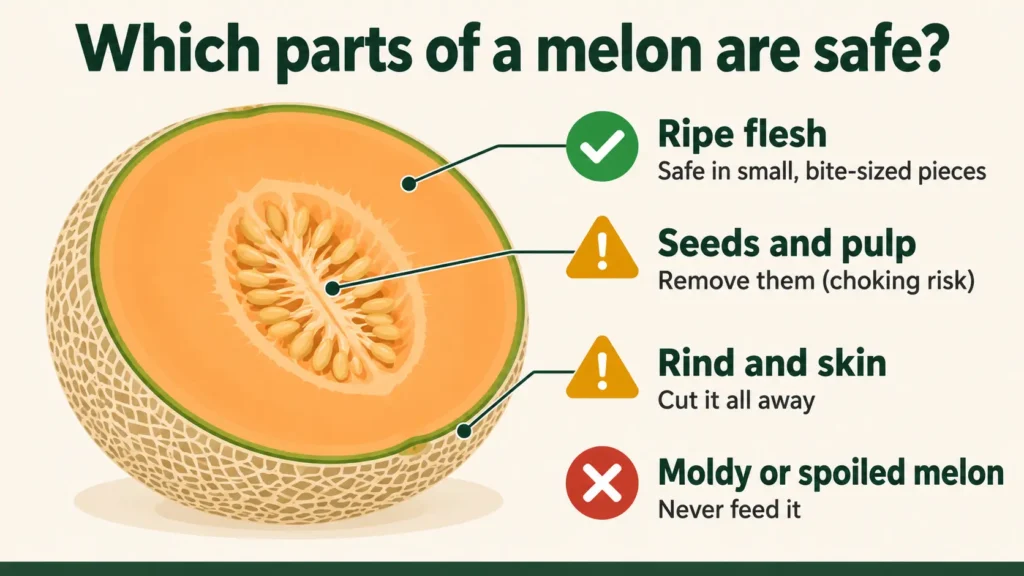
| Part | Verdict | Why |
|---|---|---|
| Ripe flesh | ✅ | The part meant for eating |
| Seeds and stringy pulp | ⚠️ | Not toxic, but a choking risk |
| Rind | ⚠️ | Tough to chew and digest. A swallowed chunk can cause a blockage |
| Netted outer skin | ⚠️ | The rough net on a cantaloupe can hold dirt and bacteria |
| Moldy or spoiled parts | 🛑 | Mold can produce toxins that make dogs sick |
The outside of a melon touches soil, hands, and shelves before it reaches your kitchen, and cantaloupes have been linked to foodborne illness outbreaks in people (see the FDA and CDC). When you slice an unwashed melon, the knife can carry whatever is on the surface into the flesh. Rinse the whole melon under running water before you cut it, even if you plan to discard the rind.
Can Dogs Eat Honeydew? Honeydew vs. Cantaloupe
Yes. Can dogs eat honeydew? Honeydew flesh is as safe as cantaloupe flesh, with the same rind and seed rules. Can dogs have honeydew melon the way they have cantaloupe? Yes: ripe flesh only, in small pieces, with the rind and seeds removed.
| Cantaloupe | Honeydew | |
|---|---|---|
| Flesh color | Orange | Pale green |
| Skin | Rough, netted | Smooth |
| Beta-carotene | More | Very little |
| Flesh for dogs | ✅ Small pieces | ✅ Small pieces |
| Rind and seeds | Remove | Remove |
If your dog likes one, there is no reason to avoid the other. Can dogs eat cantaloupe and honeydew together? Yes, you can serve them side by side as long as the combined amount is still a small treat.
Can Dogs Eat Melon? Other Types and Watermelon
Yes. Can dogs eat melon in general? The same rules apply across the melon family: ripe flesh is fine in small amounts, and the rind and seeds come off.
Other melons. Galia, Crenshaw, casaba, and similar melons are close relatives, so the same logic holds.
Watermelon. Technically a different species, but the preparation rules are nearly identical, and the rind is again the part to avoid. See our guide on can dogs eat watermelon for the details.
Whichever melon you choose, pick one that is ripe and unblemished, and throw out any with soft spots, mold, or a fermented smell.
Can Dogs Eat Cantaloupe Rind or Skin?
Can dogs eat cantaloupe rind? No. Cut the rind off. It is not poisonous, but it is a poor food for dogs for three reasons:
- It is tough. Dogs that gulp food may swallow large pieces without chewing them well, which is a choking hazard.
- It is hard to digest. A large piece can irritate the stomach, and in the worst case it can lodge in the intestines and cause a blockage. The risk is greatest for small dogs, but any dog can have a problem.
- It touches the outside world. The net-like skin is hard to clean fully, which is one more reason not to hand it over as a chew.
If your dog swallowed a large piece of rind, or a lot of it, call your veterinarian for guidance even if your dog seems fine. A blockage can take time to show up. For a very small piece, watch your dog closely and call if any sign appears (see the sections below).
Can Dogs Eat Cantaloupe Seeds?
Can dogs eat cantaloupe seeds? They are not toxic. The AKC describes them as harmless but advises against feeding them on purpose, because they can be a choking hazard, and PetMD advises removing them. So scoop them out, along with the stringy pulp around them. It takes a few seconds, and it removes one more thing to worry about.
Can Dogs Eat Cantaloupe Every Day?
It is better to keep it occasional. Can dogs eat cantaloupe every day? A healthy dog can have a small piece on many days without trouble, but there are good reasons to treat melon as a snack and not a habit:
- It is not nutritionally complete. Your dog’s main diet should supply what it needs. Treats should not crowd it out.
- The sugar adds up. Melon is mostly water, but the natural sugar is real. A little is fine. A lot, every day, is not what a dog needs.
- The 10% rule applies. Treats of all kinds should make up no more than about 10% of your dog’s daily calories. Melon counts, along with biscuits, chews, and dental sticks.
- Fresh does not mean unlimited. It is easy to think “it’s just fruit” and keep handing out pieces. Too much causes gas, loose stools, or an upset stomach.
If your dog has diabetes, or is on a weight management plan, ask your veterinarian before adding melon to the diet.
Can Dogs Have Cantaloupe? How Much Is Too Much
There is no single amount that suits every dog, and we do not give a gram figure because no reliable one exists. A simple gradation works better:
- Start tiny. For a dog that has never had melon, offer one or two small pieces and wait. If the stomach stays settled, you can offer a little more next time.
- Make the pieces small. PetMD suggests pieces of about half an inch, with no rind or seeds. Smaller dogs need smaller pieces as well as fewer of them.
- Think “treat,” not “serving.“ A few cubes spread across a day is a treat. A whole bowl is a meal, and not a good one.
- Adjust the meals. If you give melon regularly, keep your dog’s overall calories in balance.
Can Small Dogs and Large Breeds Eat Cantaloupe?
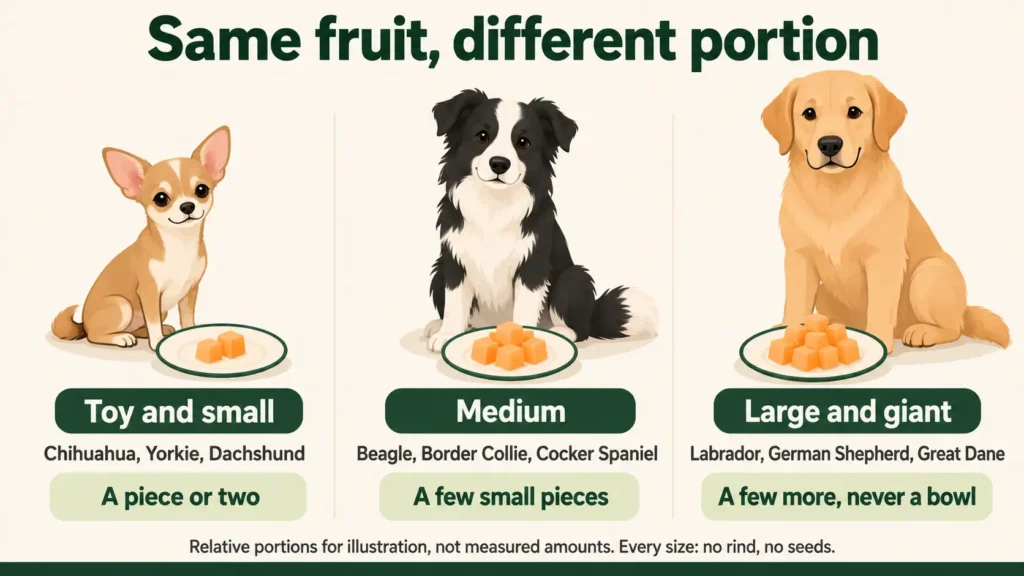
The fruit doesn’t change. Cantaloupe is just as safe for a Chihuahua as it is for a Border Collie. What changes is how little of it counts as a portion, and how much a stray piece of rind or a pile of seeds matters.
Chart comparing relative melon portions for toy and small, medium, and large and giant dog breeds
Small and toy breeds. Chihuahuas, Yorkies, Pomeranians, and Dachshunds need very small portions: a piece or two, cut small. A swallowed chunk of rind is far more likely to cause trouble in a small dog, so be strict about removing it.
Medium dogs. Beagles, Cocker Spaniels, and Border Collies can have a few small pieces as an occasional treat. Cut them small enough to chew, not swallow whole.
Large and giant breeds. Labradors, German Shepherds, and Great Danes can have a few more pieces, but “more” is relative. A big dog still needs the same preparation and a reasonable limit.
Active and working breeds. Border Collies, Australian Shepherds, and Huskies burn more calories, but that doesn’t make cantaloupe a free food. Extra energy needs are better met by adjusting main meals than by adding treats.
Breeds with a wide weight range. Poodles, Dachshunds, and Spaniels vary enormously within the same breed name. Go by your dog’s actual weight, not the breed label.
Breeds prone to weight gain. Labradors, Beagles, Pugs, and Cocker Spaniels gain weight easily, and fruit calories count too. Keep melon to a small, occasional treat.
Puppies. Puppies have smaller stomachs and less tolerance for anything new. Offer a tiny piece, watch how they react, and ask your veterinarian before making fruit a regular part of a puppy’s diet.
The risk that really does change with size is the rind. A Great Dane may pass a chunk without noticing, while the same piece can block a toy breed’s intestines. That is why the rule is the same for every dog: take it off.
Size changes the portion, not the form. Melon juice, canned fruit, and sweetened melon products are off-limits for every dog at every weight. A large dog does not get a pass on them.
If your dog has diabetes or is on a weight management plan, ask your veterinarian regardless of breed or size.
📥 Free Download: Safe & Toxic Foods Chart for Dogs
Melon Products to Skip
The fruit is safe. Most things made from it are not. Can dogs eat cantaloupe in processed forms? Mostly no.
Two-column chart of fresh melon that is fine for dogs versus melon products and parts to skip
- Melon juice and smoothies. Juice removes the fiber and leaves concentrated sugar. Many store-bought juices also contain added sugar.
- Canned melon and fruit cocktail. Canned fruit usually sits in syrup. Fruit cocktail and fruit salad mixes can also contain grapes or raisins, which are toxic to dogs. See can dogs eat grapes.
- Store-bought dried melon. Drying concentrates the sugar, and commercial versions often add more.
- Melon-flavored foods and sweets. Gum, candy, ice cream, sorbet, yogurt, and baked goods may contain added sugar or xylitol, which is poisonous to dogs. Read our guide on xylitol poisoning in dogs.
- Melon with salty or cured foods. Melon wrapped in cured meat is a salt and fat problem, not a melon problem.
- Melon in cocktails or liqueurs. Alcohol is dangerous for dogs. See can dogs drink alcohol.
The same pattern runs through every item: fresh, plain fruit is the safe choice, and processing adds sugar, salt, or ingredients that change the verdict. Our guide to processed foods for dogs explains why.
What If My Dog Ate Too Much Cantaloupe, or the Rind?
If your dog ate too much melon flesh. Can dogs eat cantaloupe in large amounts without trouble? Not usually. The usual result is a mild stomach upset: gas, loose stools, or diarrhea. Skip the melon, keep fresh water available, and watch your dog. Call your veterinarian if you see:
- Vomiting
- Loss of appetite
- Unusual tiredness
- A painful or bloated belly
- Diarrhea that is severe, keeps getting worse, or does not settle
If your dog ate the rind. The concern is a blockage. For a large piece or a lot of rind, call your veterinarian even if your dog seems normal. For a very small piece, watch closely and call promptly if you notice repeated vomiting, loss of appetite, a swollen or painful belly, straining to pass stool or no stool at all, or hiding.
If your dog ate a lot of seeds. One or two stray seeds are unlikely to cause a problem. A large amount, especially in a small dog, is worth a call.
If your dog ate moldy melon. Treat this as more serious. Mold can produce toxins that affect the nervous system, and symptoms can include vomiting, tremors, or unsteadiness. Contact your veterinarian or a pet poison hotline right away; do not wait for symptoms.
How to Prepare and Serve Cantaloupe for Dogs
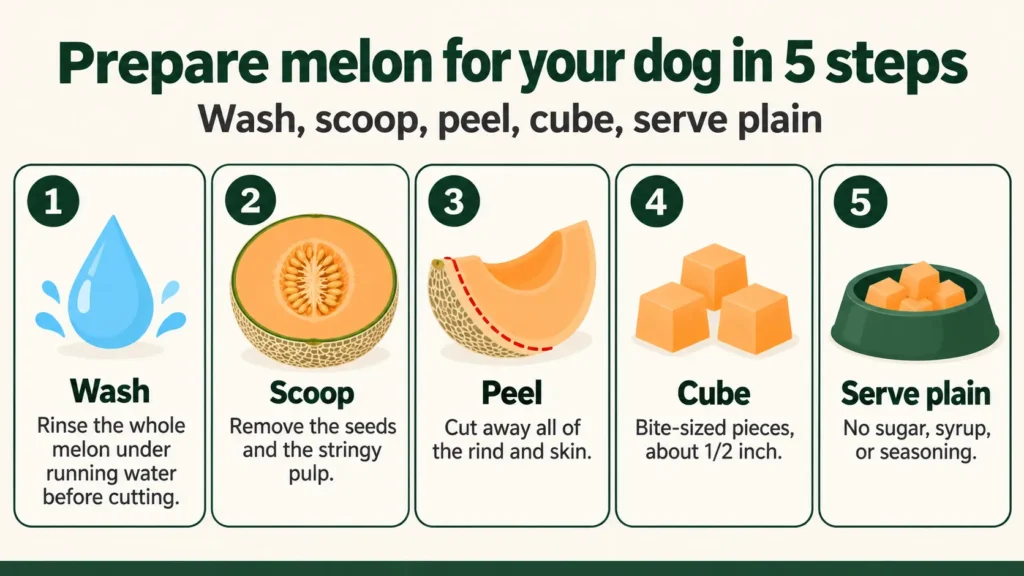
Five-step guide to preparing melon for dogs: wash, scoop out seeds, peel off the rind, cut into cubes, serve plain
Can dogs eat cantaloupe raw? Yes. Raw and plain is the best way to serve it, as long as it is prepared as below.
- Pick a ripe, undamaged melon. Skip any with soft spots, mold, or a sour or fermented smell.
- Wash the whole melon. Rinse the outside under running water and scrub the skin gently before you cut it.
- Cut it open and scoop out the seeds and pulp.
- Remove all the rind. Cut the flesh away from the skin completely.
- Cut the flesh into small pieces, about half an inch for most dogs, smaller for small ones.
- Serve it plain. No sugar, honey, syrup, or seasoning.
- Store leftovers in the fridge. Throw them out if they turn soft, sour, or slimy.
Serving ideas
- Fresh cubes as a treat or training reward, straight from the fridge if you like.
- Food topper. Mash a small amount and stir it into your dog’s regular food.
- Frozen treat. Mash it, spoon it into a lick mat or a stuffable toy, and freeze it.
- Frozen pieces. Small frozen cubes cool a dog down on a warm day. Keep them small and supervise, since hard frozen chunks can be a choking hazard.
- Yogurt mix. Stir mashed melon into plain, unsweetened, xylitol-free yogurt. Some dogs have trouble with dairy, so start with a little.
- Homemade dried melon. Drying concentrates the sugar, so offer far less than you would of fresh melon.
When to Call Your Veterinarian Right Away
Contact your veterinarian, an emergency clinic, or a pet poison hotline promptly if your dog:
- Ate moldy or spoiled melon
- Swallowed a large piece of rind, or a lot of rind
- Is vomiting repeatedly, or has diarrhea that does not settle
- Has a bloated, hard, or painful belly
- Shows weakness, tremors, or collapse
- Ate melon sweets or baked goods that may contain xylitol
- Has a medical condition such as diabetes and ate a large amount of melon
Can dogs eat cantaloupe safely with a medical condition? Sometimes, but ask first. If you are in the US, ASPCA Animal Poison Control and the Pet Poison Helpline both offer round-the-clock advice; a consultation fee usually applies. When in doubt, call. It is always better to ask early.
Myth vs Fact
Myth: Because it’s fruit, a dog can have as much as it wants. Fact: Melon contains natural sugar and calories, and it counts toward the 10% treat limit. Too much can upset the stomach.
Myth: The rind is full of fiber, so it’s good for digestion. Fact: Rind is tough and hard to digest, and a swallowed chunk can cause a blockage. It is best removed.
Myth: Seeds are poisonous. Fact: Cantaloupe seeds are not toxic, but they are a choking risk, so they are best removed.
Myth: Honeydew is riskier than cantaloupe, or the other way around. Fact: The same rules apply to both: ripe flesh yes, rind and seeds no.
Myth: Dogs need fruit for vitamin C. Fact: Dogs make their own vitamin C, and a complete and balanced dog food covers their needs. Melon is a treat, not a requirement.
FAQ
Can puppies eat cantaloupe?
Puppies can usually have a tiny piece of ripe cantaloupe flesh once they are eating solid food, but their digestive systems are more sensitive. Start with a very small amount, remove all rind and seeds, and ask your veterinarian before making it a regular treat.
Can dogs eat frozen cantaloupe?
Yes, if you prepare it the same way: no rind, no seeds. Freeze small pieces, not big chunks, because hard frozen pieces can be a choking hazard or hard on teeth. Supervise your dog while it eats.
Is cantaloupe safe for diabetic or overweight dogs?
Melon contains natural sugar and calories. Some sources call it a good low-calorie treat for overweight dogs, but it may not suit a diabetic dog. If your dog has diabetes or needs to lose weight, ask your veterinarian before giving it.
Can dogs eat cantaloupe and watermelon or other fruit together?
Yes, cantaloupe and watermelon can be served together, as long as each fruit is safe and prepared properly and the combined amount is small. Check every ingredient in a fruit salad, and make sure it contains no grapes or raisins. Other safe options include mango and blueberries, in small amounts.
Can dogs eat cantaloupe with a sensitive stomach?
Possibly, in a very small amount, but fruit can upset a sensitive digestive system. Start with one tiny piece, watch your dog, and ask your veterinarian if stomach problems are a recurring issue.
Which is better for dogs, cantaloupe or honeydew?
Neither is better. Both are safe as ripe flesh, and both need the rind and seeds removed. Cantaloupe contains more beta-carotene, while honeydew is a little milder. Choose the one your dog prefers and keep the portion small.
Can dogs drink melon juice?
It is best to skip it. Juice leaves out the fiber and concentrates the sugar, and store-bought versions often include added sugar. Fresh flesh is a better choice.
The Bottom Line
So, can dogs eat cantaloupe? Yes. Ripe cantaloupe and honeydew flesh is a safe, light treat for dogs of every size when it is served in small pieces and in moderation. The rind and seeds should always come off, moldy or spoiled melon should never be fed, and juice, canned fruit, and sweetened melon products are best avoided. Keep the portion small, keep it occasional, and adjust for your dog’s size. If your dog has a health condition such as diabetes, ask your veterinarian first.
Disclaimer
Written by the Dog Nutrition Hub Editorial Team and fact-checked against published veterinary and nutritional sources. It has not been reviewed by a veterinarian. This article is for general educational purposes only and is not a substitute for professional veterinary advice, diagnosis, or treatment. Always consult a licensed veterinarian about your dog’s health. See our Medical Disclaimer.
Last updated: October 28, 2026